PROLOGUE: The Sovereign Wake-Up Call
While you read this, the biological clockwork inside your ribcage is running an irreversible subtraction. Mitochondria age. Telomeres fray at the margins. The unrepeatable morning you were handed hours ago has already decayed into the permanent, unalterable ledger of the past. Nature operates without malice, but it operates with absolute, mechanical cruelty: anything in an organism that is not actively demanded is quietly reabsorbed, decommissioned, and liquidated.
The tragedy of modern existence is rarely catastrophic ruin. Empires of character do not implode in an instant of theatrical defiance; they rot from the perimeter inward while the inhabitant sits comfortably inside, admiring the upholstery. You woke up today harboring the narcotic belief that your capacities are waiting for you at full scale—that your courage, your intellect, and your tolerance for agony are stored in a pristine vault, ready to be deployed whenever you finally decide the stakes are high enough. This is a lethal hallucination.
Capacity is not a static bank account; it is a pressurized vessel. The moment you insulate yourself from the biting cold of demanding labor, the pressure drops. Comfort lowers the ceiling quietly. It does not sound a horn. It does not shatter glass. It simply moves the boundaries of what you are capable of enduring two inches lower while you sleep, so that when you finally stand upright to claim your life, you strike your head against a ceiling you never saw descend.
CHAPTER I: The Anatomy of the Signal
To deconstruct this signal from first principles, one must understand the hidden physics of human stasis. There is no horizontal line in the human condition. The concept of “holding the line” while lounging in ease is a geometric impossibility invented by the rationalizing ego. You are either pressing upward against the downward gravitational pull of entropy, or the weight of entropy is pressing you down into the sediment.
The Stoics understood this not as moralizing theology, but as elemental physics. Chrysippus likened the human soul to a cylinder on a steep incline: once released, its nature is to roll downward unless continuous counter-force is exerted against its surface. When you introduce ease, leisure without victory, and thermal, physical, and psychological cushioning into your day, you do not pause your momentum—you surrender to the slope.
“It is a rough road that leads to the heights of greatness,” Seneca recorded, not as poetry, but as a severe diagnostic. “He who shuns the rough path finds his limbs softened, his breath shortened, and his palace turned into a sepulcher.”
The operative terror of the signal lies in the word quietly. Catastrophe is loud. Bankruptcy, physical injury, public humiliation, and outright failure carry a visceral resonance that shocks the nervous system into emergency repair. If an enemy struck you with a hammer, your defensive biology would mobilize immediately. Adrenaline would surge, your vision would narrow, and your pride would organize an immediate counter-offensive. But comfort does not strike you with a hammer; it wraps you in heated wool. It replaces the friction of the arena with the smooth, padded surfaces of frictionless convenience.
Under the influence of comfort, the mind performs an insidious trick of perspective: it mistakes the absence of pain for the presence of peace. You convince yourself that because you are untroubled, you are safe. In reality, your operational range—the sovereign headroom within which your soul can maneuver, conquer, and create—is being compressed. The ceiling drops down toward the floor, suffocating your ultimate reach, until the smallest draft of real-world adversity feels like an unendurable tempest.
CHAPTER II: The Historical Crucible
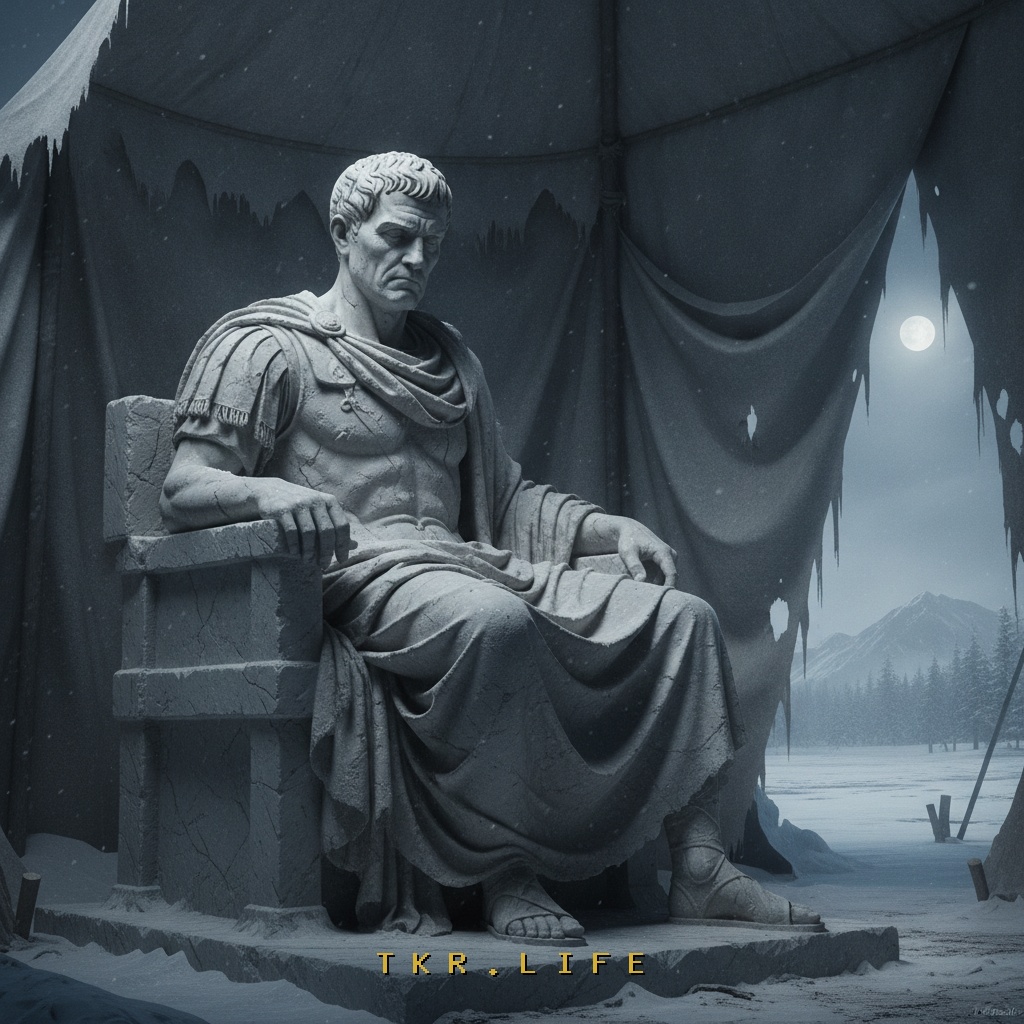
Consider the winter of 174 AD along the frozen bend of the Danube. Marcus Aurelius Antoninus, undisputed master of the Mediterranean basin, did not inhabit the marble halls of the Palatine Hill, where underfloor heating carried the warmth of oak fires through the walls, and where Syrian vintage wine flowed at the gesture of a ringed finger. He lived in the mud of Carnuntum and Sirmium, on the hostile front lines of the Marcomannic Wars.
His body was wrecked. His chest rattled with chronic pulmonary distress; his stomach rejected food so violently that he lived on mere morsels of bread soaked in bitter wine; his sleep was shredded by the screaming of sentries and the relentless wind biting off the Sarmatian plains. Every physician, courtier, and senator in Rome sent missives begging him to return to the capital—to command the war by proxy from the safety of an imperial couch.
Had Marcus returned to comfort, the ceiling of the Roman state would have plummeted instantly. More critically, the ceiling of his own internal citadel would have collapsed. He understood that the moment an emperor permits himself to believe that comfort is his birthright, he becomes a slave to the things that preserve it. In his private journal—penned by tallow lamp with swollen, arthritic fingers while his soldiers froze in the trenches outside—he waged an unsparing war against his own biological longing for ease:
“At dawn, when you have trouble getting out of bed, tell yourself: ‘I have to go to work—as a human being. What do I have to complain of, if I’m going to do what I was born for—the things I was brought into the world to do? Or is this what I was created for? To huddle under the blankets and stay warm?'”
Marcus recognized that warmth under the blankets was not an innocent recovery state; it was a lethal compromise with mediocrity. By subjecting his frail, failing anatomy to the brutal discipline of the northern limes, he maintained the ceiling of the empire at its highest historical watermark. He refused to allow comfort to dictate the terms of his reign. He died not as a pampered monarch suffocated by tapestries, but on his feet, on the edge of the known world, with his boots deep in the freezing earth.
CHAPTER III: The Biological Ledger & The Hidden Tax of Hesitation
Let us strip away sentiment and look at the brutal arithmetic of your biological ledger. You possess, at maximum, roughly four thousand weeks of existence upon this rock. If you are reading this in the prime of your adulthood, more than two thousand of those weeks have already evaporated into the ether. Of what remains, less than one-third constitutes peak cognitive, hormonal, and physical vitality.
Every single day presents you with an allotment of sovereign daylight—approximately fourteen to sixteen waking hours. When you select comfort—when you delay the difficult phone call, postpone the punishing physical output, linger over an aimless digital feed, or retreat into passive entertainment—you are paying a catastrophic hidden tax. You are not merely losing time; you are systematically re-engineering your neurobiology for submission.
The human brain is a ruthlessly efficient, homeostatic prediction engine. It maps your operational norms through the mechanism of allostasis. When you consistently avoid high-friction environments, your nervous system interprets high friction as an existential threat. It begins to down-regulate your dopamine receptors, diminish your cold-shock resilience, and atrophy the dorsal anterior cingulate cortex—the structural hub of will and tenacity.
The tax of hesitation operates like compound interest in reverse:
- The First Day of Retreat: Hesitation creates a minor neurological precedent. The task appears five percent more daunting because you signaled to your nervous system that you are incapable of executing it under current conditions.
- The Thirtieth Day of Retreat: The avoidance pathway is now myelinated. What was once a minor hurdle is now perceived by the amygdala as an unscalable cliff. The ceiling has descended quietly by an inch.
- The Thousandth Day of Retreat: You have fully habituated to low-voltage existence. You look up at the heights you once intended to conquer and conclude, via cowardly self-justification, that “it was never that important anyway.”
This is how ceilings fall: not with the thunderclap of defeat, but with the quiet, cowardly whisper of rationalization. You pay the tax with the currency of your sovereign potential, and you receive in return a handful of soft, warm dust.
CHAPTER IV: Modern Sedation vs Sovereign Output
We inhabit an era engineered by commercial interests to be an ambient sedative. Never in human history has a civilization invested so much cognitive capital, computing power, and behavioral psychology into the singular objective of keeping human beings passive, pacified, and comfortably horizontal.
Look around you with cold, unsparing eyes. The modern consumer landscape is a web of velvet snares designed to eliminate every trace of physical and cognitive friction:
- Hyper-Palatable Nutrition: Chemical compounds disguised as food, engineered to spike dopamine and induce metabolic torpor so profound that movement becomes an agony.
- Algorithmic Trance Machines: Infinite digital feeds calibrated to mimic the foraging reward loop, holding your prefrontal cortex in a state of suspended animation while your sovereign daylight burns to ash.
- Thermal Monotony: Perpetual climate control that insulates the human animal from the vital, biological shock of seasonal temperatures, softening the endocrine system until a four-degree variance in ambient air triggers emotional distress.
There is a vast, trillion-dollar industrial complex that profits exclusively off the lowering of your personal ceiling. A sovereign human being who thrives on friction, who requires neither artificial stimulation to awaken nor digital sedation to sleep, is an economic anomaly. He cannot be easily marketed to; he cannot be paralyzed by manufactured panics; he cannot be herded into the pen of passive consumption.
Sovereign output requires an active, violent rejection of this ambient anesthesia. It requires you to treat everyday conveniences not as benevolent gifts, but as hostile tests of your internal resistance. If your environment demands nothing of you, you must demand everything of yourself. You must intentionally erect walls of friction where the world offers you cushions, or prepare to accept a life lived entirely on your knees.
CHAPTER V: The 5 Sovereign Battle Protocols for Today
Stoicism is not a parlor philosophy; it is an operating system for mortal struggle. You have twelve hours of functional daylight remaining. Do not read these protocols as abstract theory. Treat them as rules of engagement for the immediate theater of your day.
1. The Protocol of Deliberate Thermal or Physical Rupture
Within the first sixty minutes of your day, you must subject your physiology to an unavoidable, non-negotiable friction event. A five-minute ice-cold shower where you do not permit your breathing to become ragged; a brutally paced sprint uphill until your lungs taste copper; or a set of heavy compound movements executed in absolute silence. Objective: Instantly remind your nervous system that comfort is not the baseline of this organism.
2. The Horizon Squeeze (Zero Buffering)
Identify the single most demanding, consequential task on your ledger today—the one that triggers the quiet urge to check your phone, clean your desk, or reorganize your schedule. Eliminate the buffering zone entirely. Do not count down from five; do not prepare a hot beverage; do not clear your workspace. Move directly from identification into execution within four seconds. Strike the friction before the rationalizing mind can formulate an escape route.
3. The Monotask Quarantine
Sever every digital lifeline for an uninterrupted block of one hundred and twenty minutes. Close all background tabs. Place your communication devices in another room behind a closed door. Enter the work as if you were an ancient scribe in a stone monastery or a gladiator stepping onto the sand. If your mind wanders, permit it to stare at the blank wall, but under no circumstance offer it the pacifier of a digital notification. Force the brain to seek dopamine exclusively through the resolution of the hard problem in front of you.
4. Radical Candor with Your Own Excuses
Listen closely to your internal dialogue today. The moment you catch yourself saying, “I am tired,” “I will be more effective tomorrow,” or “Conditions are not optimal,” translate the phrase into its raw, unadorned truth: “I am choosing temporary ease over my stated ambitions.” Speak the real sentence aloud. If you still choose the couch, do so knowing you are making a conscious surrender, not a tactical pivot. Strip your cowardice of its intellectual disguise.
5. The Voluntary Hardship Sprint
Once before sunset, intentionally reject a convenience that you could easily afford. Walk instead of driving; fast through a meal you were looking forward to; sit in a hard, upright chair instead of reclining; execute twenty minutes of deep technical study when your mind pleads for entertainment. Treat this not as ascetic self-flagellation, but as structural maintenance on your internal machinery. Keep the ceiling pressed upward with both hands.
CHAPTER VI: The Evening Ledger & Mental Audit
Tonight, when the sounds of the world diminish and you are left alone in the dark with nothing but your conscience, you must conduct the evening audit. Seneca described this process as summoning the soul before the supreme tribunal of the self: “When the light has been removed and my wife has fallen silent, aware of this habit that is now mine, I examine my entire day and go back over what I have done and said, hiding nothing from myself, passing nothing by.”
Sit upright in the dark. Do not pick up your phone. Ask yourself these four piercing questions and write down the answers with uncompromising honesty:
- Where did I contract today? Where did I step back from the heat of the fire, choosing the soft explanation instead of the blunt effort, and how much did that retreat cost my dignity?
- Did I mistake mere activity for sovereign advancement? Was I genuinely striking at the core of my life’s work, or was I merely busying myself with administrative trivia to evade the terror of deep focus?
- What ceiling did I lower? Did I accept a lower standard of speech, a lower threshold of physical endurance, or a weaker boundary against distraction, allowing the walls to move closer inward?
- If this day were the final measure of my character, would it testify to an untamed master or a domestic pet? Strip away your intentions, your hopes, and your internal narratives. Judge yourself solely on the cold, physical evidence left behind on the earth today.
EPILOGUE: Closing Conviction
The universe does not care about your potential. The soil beneath your feet will take your bones with the exact same indifference whether you spent your life storming the battlements of your own capacity or rotting peacefully on a feather bed. Potential that is not forged into sovereign output is merely a tragedy dressed in vanity.
Look up right now. Look at the invisible ceiling above your thoughts, above your discipline, above your life. It is not made of stone; it is made of habits, tolerances, and the invisible choices you make every hour. If you do not push against it with the full weight of your will today, it will settle down upon you, silent and suffocating, until your world has shrunk to the width of a grave.
Stand up. Throw off the soft blankets of your manufactured comfort. Step out onto the frozen front lines of your own existence, take the cold air into your lungs, and push the ceiling back to the stars.