PROLOGUE: The Sovereign Wake-Up Call
At this precise second, your biological clock is discharging an unrecoverable slice of your mortal capital. There is no escrow account for human vitality. The pulse thumping against your radial artery is not an indefinite grant; it is a metronome counting down to zero. Yet the overwhelming majority of human beings live under the cowardly hallucination that their baseline resilience is a fixed, dormant asset—a biological savings bond waiting to be cashed when fate finally demands greatness.
It is an absolute lie. Biology recognizes no dormant sovereignty. Your flesh, your synapses, and your vagal pathways are ruthlessly economic engines. They do not maintain capabilities you do not routinely exhaust. If your day consists of soft negotiations, ambient distractions, and the habitual evasion of high-friction tasks, your nervous system calibrates down to that exact, pathetic perimeter. It does not hold the line; it surrenders ground. You become biologically incapable of bearing what you refuse to carry today.
Look at the room you are sitting in. Look at your hands. The hours ahead of you will not recur. If you permit your neural pathways to marinate in the warm bath of low demand, do not dare feign surprise when the inevitable catastrophe of existence shatters you. You are being sculpted in real time by the weight you run from.
CHAPTER I: The Anatomy of the Signal
The signal is immutable: Your nervous system adapts to demand. Not to your intentions. Not to your fragile manifestos, your aesthetic journals, or your late-night vows of self-reinvention. Your nervous system is a physical substrate governed by the laws of energy conservation and allostasis. It responds exclusively to applied load.
The ancient Stoics understood this long before the advent of modern neuroscience. When Epictetus interrogated his students in the freezing mornings of Nicopolis, he did not inquire about their intellectual vanity; he demanded to know how their hegemonikon—the ruling center of the mind—performed when real friction was applied. He observed that men who lived in sheltered ease wept at a harsh word, collapsed under modest poverty, and went mad when confronted by sovereign tyranny. Why? Because an under-demanded nervous system interprets any escalation of reality as an existential threat.
“Why do you wonder that you are weak in those things in which you have had no training, and in which you have applied no labor?” — Epictetus
Modern humans drift because they labor under the modern myth of the “safe reserve.” They believe that one day, when the great calling arrives—when the venture is launched, when the crisis strikes, when life forces them onto the front line—their nervous system will spontaneously summon Herculean composure. This is physiological fantasy. If you demand nothing of your attention, your prefrontal cortex downregulates executive control. If you demand no tolerance of discomfort, your amygdala becomes hyper-sensitized to trivial friction. If you demand no stillness under acute pressure, your autonomic nervous system defaults to frantic, disorganized reactivity.
Your nervous system does not anticipate greatness; it reflects your history of applied force. If you ask for survival through triviality, it equips you only for triviality.
CHAPTER II: The Historical Crucible
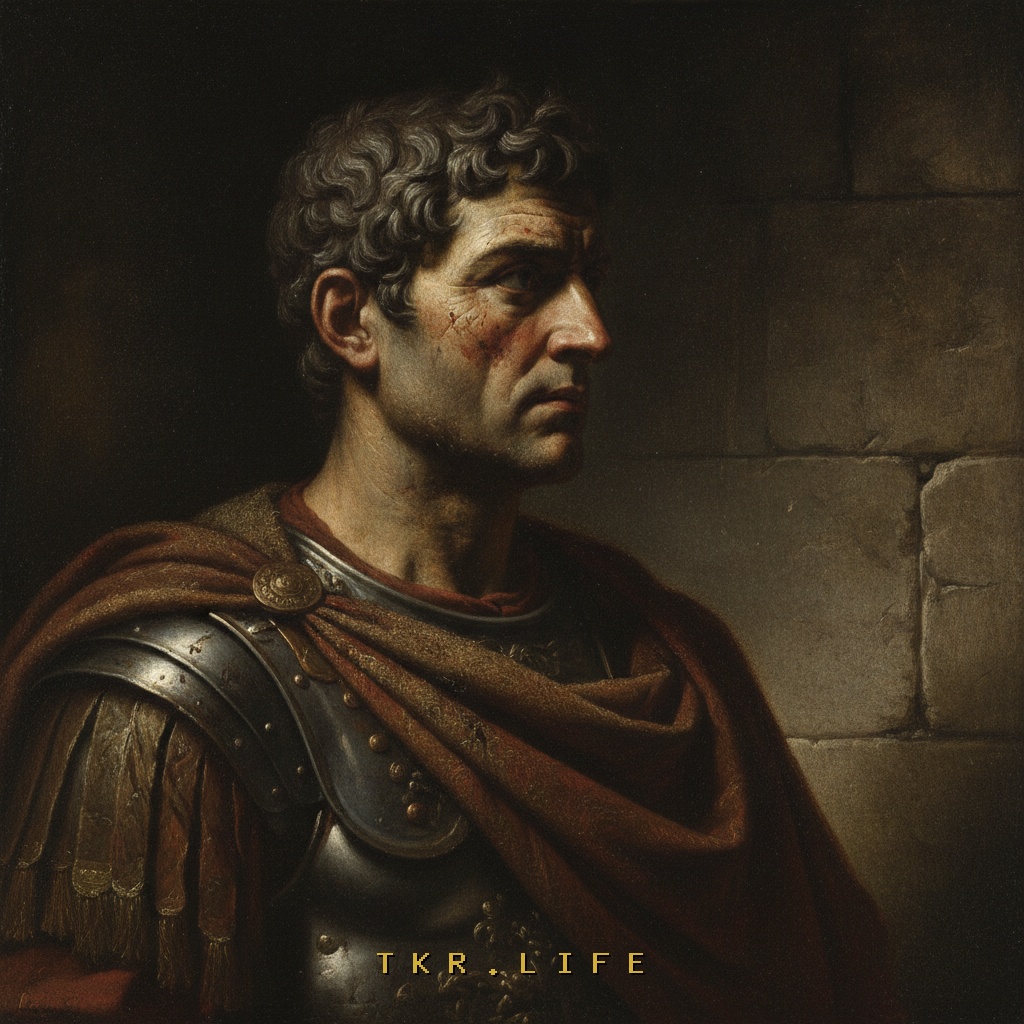
Consider the winter of 174 AD. On the frozen northern frontier of the Danube River, the Roman emperor Marcus Aurelius did not govern from the marble colonnades of the Palatine Hill. He lived in the mud, the rot, and the sub-zero squalor of Carnuntum, surrounded by hostile Germanic tribes who butchered Roman cohorts with merciless efficiency. Behind him, the empire was being ravaged by the Antonine plague—a pandemic so lethal that wagons dragged hundreds of corpses through the streets of Rome every morning.
Marcus was not an inherently rugged warrior; he was an asthmatic, sickly intellectual whose chest was frequently racked with violent coughing spells and whose digestive system was perpetually inflamed. By all conventional logic, his nervous system should have disintegrated into hysterical collapse. Nero’s court would have fled; Caligula would have drowned in paranoia. Yet Marcus sat in his military tent, wrapped in a coarse wool cloak, beneath the flickering light of an oil lamp, penning the private entries of his Meditations.
He did not attain that supernatural, granite composure through divine intervention. He attained it because his nervous system had been subjected to uncompromising daily demand. For decades, he had forced his perception to strip every human vanity down to its raw mechanics. When faced with the horror of severed limbs, dying soldiers, and the impending collapse of the Western world, his nervous system did not redline into panic. It had been systematically conditioned to process sheer catastrophe as merely another neutral piece of material to be worked by virtue.
Marcus demanded that his mind maintain absolute clarity when his body was freezing and his lungs were failing. The demand was immense; therefore, his neurological architecture reorganized itself around the demand. His stillness was not born of peace; it was forged in an environment of total pressure.
CHAPTER III: The Biological Ledger & The Hidden Tax of Hesitation
Every time you retreat from a high-friction engagement, you are not simply postponing an event; you are casting an active biological vote for your own degradation. Neural plasticity is bidirectional. Myelination—the insulation of neural pathways that makes cognitive processing and behavioral execution rapid, fluid, and robust—occurs precisely around circuits that are repeatedly fired under intense demand.
When you sit before a high-leverage decision and hesitate, your brain is actively insulating the neural circuitry of doubt. You are training your nervous system to associate cognitive friction with retreat. Over months and years, this builds a formidable, automatic architecture of hesitation. The tax of this hesitation is catastrophic. It is not paid in lost minutes; it is paid in structural decay.
- The Atrophy of the Allostatic Threshold: When you consistently shelter yourself from stress, your autonomic baseline sinks. A difficult conversation begins to elevate your resting heart rate to panic levels. A demanding workload triggers cognitive exhaustion. You become functionally brittle.
- The Dilution of Dopaminergic Baselines: By demanding little effort for high immediate stimulation, your neurological reward system becomes decoupled from toil. You become addicted to effortless dopamine, rendering sustained, deep work biologically repulsive.
- The Loss of Temporal Sovereignty: You begin to view hours as abundant and expendable rather than as a finite, non-negotiable allocation of biological daylight.
Hesitation is not empty space; it is active training in weakness. Your nervous system learns that when reality presses hard, your standard protocol is to flinch.
CHAPTER IV: Modern Sedation vs Sovereign Output
We inhabit a civilizational architecture deliberately engineered to reduce demand on your nervous system. The algorithms governing your devices are tuned to optimize for one metric: passive compliance. The notification trance, the infinite algorithmic scroll, the ambient micro-pleasures of the digital panopticon—all of these are engineered pacifiers. They invite your nervous system to sink into a state of docile, parasympathetic stupor interrupted only by trivial, synthetic outrage.
The societal incentive is to keep you predictable, dependent, and emotionally volatile. A sovereign individual with an uncompromising nervous system—one who can sit undisturbed in sustained cognitive focus for hours, whose heart rate remains steady in the face of financial or social threat, who cannot be provoked by digital ephemera—is entirely useless to the attention economy.
Modern culture categorizes genuine friction as trauma. It encourages you to interpret any sustained demand on your intellectual or somatic capacity as an imposition against your well-being. This is how empires of weaklings are cultivated. When a society trains its populace to flee from friction, it creates individuals who cannot govern themselves, cannot create enduring monuments, and cannot defend their own minds against the simplest psychological coercion.
Sovereign output is the antithesis of this sedation. It requires you to place deliberate, voluntary, crushing demands upon yourself before the world places involuntary demands upon you. You must become your own tyrant before fate makes you a slave.
CHAPTER V: The 5 Sovereign Battle Protocols for Today
You will not transform your neurology through philosophical contemplation alone. You must alter the physical inputs of your day. For the next twelve hours, enforce these five non-negotiable battle protocols upon your flesh and mind.
1. The Zero-Deceleration Threshold
Identify the single most demanding, high-friction task currently sitting on your psychological ledger. You are prohibited from warming up to it. You are prohibited from tidying your desk, checking communication feeds, or meditating on your feelings. Move toward the point of friction with absolute zero deceleration. The instant you detect the instinct to hesitate, force physical and cognitive engagement within three seconds. Train your nervous system to treat the impulse of fear as an automated command for immediate forward movement.
2. Somatic Stillness Under Acute Influx
Throughout this day, whenever an alarming email, a hostile comment, or an unexpected setback manifests, implement an immediate somatic lockdown. For sixty seconds, force your body into absolute, statuesque immobility. Regulate your respiration into a strict four-second inhale and eight-second exhale. Forbid your facial muscles from twitching; forbid your hands from pacing. You are deliberately severing the reflex arc between external threat and autonomic panic. You are proving to your nervous system that external chaos does not dictate internal turbulence.
3. Monotasking Under Deep Cognitive Drag
Isolate your primary intellectual objective for today and work on it for a single ninety-minute block with zero ambient escape hatches. Close every tab. Lock your phone in another room. When your brain experiences the inevitable cognitive “itch”—the dull ache of sustained concentration begging for a quick hit of digital novelty—recognize it as the precise moment your neural architecture is attempting to adapt. Do not scratch the itch. Force your attention to stay locked on the friction until the timer sounds.
4. The Intentional Friction Injection
Force a moment of voluntary, acute physical demand into your day. Step into a freezing shower and remain under the water without gasping or tensing your shoulders, or subject your physical frame to heavy, uncompromising compound strain. The objective is not fitness; the objective is neurological inoculation. You are teaching your physiology that you are the sovereign who summons discomfort at will, not a victim who merely suffers it.
5. The Language of Absolute Economy
Exorcise every syllable of complaint, self-justification, and passive-aggressive venting from your speech today. When asked how you are, do not perform weakness. When confronted with an error, state the corrective action without defensive theatricality. Every word you utter is feedback to your own nervous system. When you speak the language of victimhood, your biology adjusts to support a victim. Speak with the cold, precise economy of a Roman field commander.
CHAPTER VI: The Evening Ledger & Mental Audit
When the sun collapses below the horizon and the noise of the day finally bleeds into silence, you must conduct your audit. Do not seek the warm refuge of sleep before you have squared your accounts. Sit in solitude, in the dark, and interrogate your day with brutal honesty through these four questions:
- Where did I retreat today from a necessary friction, and what specific weakness did I thereby reinforce in my neural architecture?
- Did I operate as the sovereign commander of my attention, or did I surrender my cognitive bandwidth to the engineered pacifiers of the digital mob?
- At what point did my pulse accelerate into unconscious panic, and how will I engineer greater somatic composure when that exact stimulus returns tomorrow?
- If this day were the definitive archetype of my entire existence, would it represent a life forged in monumental sovereignty, or a slow decay into soft irrelevance?
Do not grant yourself easy absolution. The ledger does not care about your excuses. Write down your answers with absolute clarity. If you failed, look at the failure directly. Acknowledge the debt, and prepare to pay it in blood and focus at the dawn.
EPILOGUE: Closing Conviction
You have been fed the poisonous lie that you are fragile, that you require endless padding, that the ultimate goal of human life is to arrive at the grave comfortably numb and undisturbed. It is the gospel of slaves.
Your nervous system is not a delicate flower; it is an ancient, formidable instrument of war, forged over millennia of scarcity, violence, and monumental human endeavor. It will give you the capacity to endure terrifying storms, to dismantle complex problems, and to exhibit chilling composure under pressure—but it will do so only if you have the courage to demand it.
The world will offer you a thousand opportunities today to look away, to lower your standards, to take the path of least resistance. Spurn them. Run toward the heavy loads. Step into the cold, cold waters of absolute responsibility. Demand more of your attention, more of your courage, and more of your will than any external master ever could. Adapt to the heights, or decay into the dust. The choice is made with your next movement.