The human animal rarely surrenders under catastrophe; it surrenders under relief. The fatal concession is never signed under heavy artillery, but negotiated in the quiet, climate-controlled perimeter where nothing demands blood from your marrow. You do not wake up one morning and consciously decide to forfeit your life’s mandate; you simply listen when the soft voice at the back of your skull suggests that the line you are holding is unnecessarily costly.
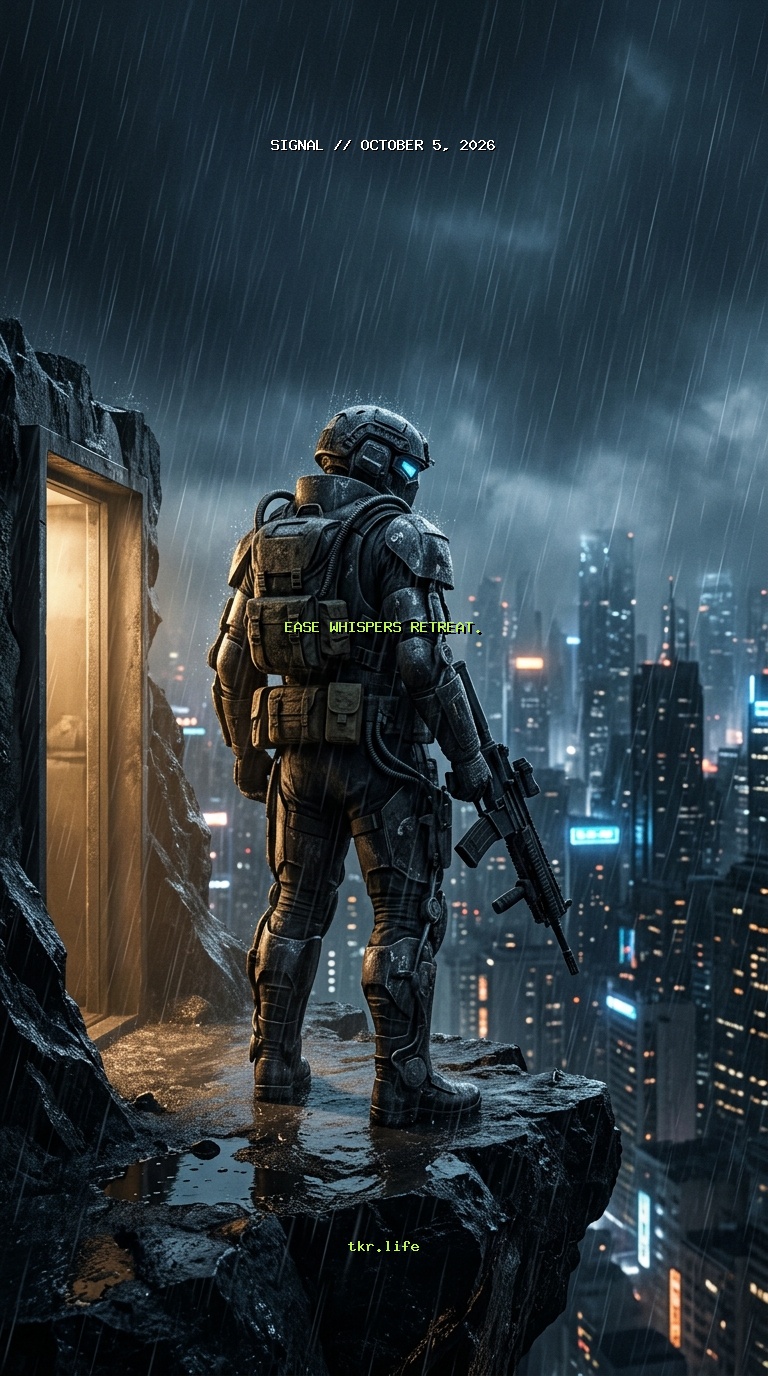
The Sedation of the Perimeter
Ease never arrives brandishing a white flag. It does not demand that you throw down your weapons and announce failure to the world. Instead, it operates through the quiet seduction of metabolic conservation. The biological machine you inhabit is ancient, hardwired for caloric preservation and shelter from the storm. When you push toward an uncompromising objective, every ancient circuit screams that you are expending irreplaceable reserves in a hostile environment.
It is in that precise friction point that ease steps forward as an advisor. It reframes desertion as prudence. It whispers that you have already proved your point, that your nervous system deserves a temporary armistice, that the assault can resume once conditions are optimal. But conditions are never optimal, and biological time does not pause while you convalesce in the shelter. The cellular clock continues its indifferent countdown whether you are advancing through the wire or lying flat in the grass.
The Arithmetic of Voluntary Ground
Every step backward taken under the influence of ease is an irreversible subtraction of operational territory. You tell yourself that stepping down your intensity is a strategic realignment—that by retreating from the edge today, you are preserving your capability for tomorrow. This is the central lie of the dying mind: the hallucination that your future self will possess greater reserves of will than the self currently crumbling under minor inconvenience.
The mathematics of human decay are straightforward: the organism adapts to the load it carries. When you drop the pack to seek comfort, you do not preserve your strength; you atrophying down to the level of the reduced burden. By the time tomorrow arrives, the fortress you abandoned has been reoccupied by inertia, and the assault will require twice the violence of action you refused to exert today.
Execute this audit on your immediate posture right now:
- Locate the quiet negotiation: Identify the single standard you dropped over the past forty-eight hours under the pretext of being “sustainable.”
- Expose the rationale: Acknowledge that the decision to pause was not tactical logistics, but an instinctive recoil from acute cognitive or physical strain.
- Reoccupy the line: Reinstate the friction point immediately, before your nervous system codifies the lower baseline as its new normal.
The grave will provide all the absolute silence and unbroken rest your tissues could ever require. Until that terminal arrest arrives, any impulse advising you to step back from the threshold is a hostile entity in your architecture. When the voice suggests you have done enough, advance ten meters and dig in.