PROLOGUE: The Sovereign Wake-Up Call
While you read these words, approximately three million red blood cells in your body will expire, incinerated by the quiet, metabolic machinery of an organism moving in one direction only: toward complete structural cessation. The room you occupy is not a sanctuary; it is a waiting room with a collapsing ceiling. The light slanting through your window marks an unrepeatable coordinate in spacetime, a fraction of daylight burned away that you will never recover, negotiate back, or re-litigate at the gates of your own demise.
Yet the defining pathology of the modern animal is not mortality; it is the grotesque, arrogant presumption that one has time to sit idly in the fog. You wait for an epistemic sunrise. You convince yourself that before you carry the weight, the map must be drawn in immaculate detail, the emotional climate must be temperate, and your neuroses must be politely settled. You believe that insight is a prerequisite for exertion.
This is the fundamental cowardice of our age. You do not think your way into clarity; you drag yourself through the teeth of resistance until the fog burns off your skin. The sovereign reality is cold, mechanical, and absolute: clarity is not a gift bestowed upon contemplation—it is the slag skimmed from the furnace of deliberate strain.
CHAPTER I: The Anatomy of the Signal
To understand why strain produces vision, one must examine the physics of materials. In engineering, photoelasticity reveals that certain transparent materials, when resting unstressed on a workbench, appear utterly uniform, indistinct, and blank. But introduce a mechanical clamp—apply torsional load, shear stress, and crushing vertical pressure—and suddenly, under polarized light, the hidden internal stress lines illuminate in blazing, iridescent bands. The force does not corrupt the specimen; the force reveals its true geometry.
The human mind operates under identical mechanical laws. Left in conditions of low friction, the intellect does not become serene; it becomes diffuse. It splinters into a thousand hypothetical tributaries, entertaining theoretical dreads, phantom resentments, and self-indulgent identity crises. The Stoic concept of tonos—the internal tension that gives structure to the soul—collapses when the external environment demands nothing of you.
“Just as nature takes every obstacle, every impediment, and works around it—turns it to its purposes, incorporates it into itself—so, too, a rational being can turn each setback into raw material and use it to achieve its goal.”
— Marcus Aurelius, Meditations, Book IV.32
When you place an organism under real, consequential strain, a violent neurological triage occurs. The auxiliary nonsense that consumed your Tuesday morning—the status anxiety, the bruised ego, the compulsive urge to refresh a digital feed, the trivial domestic grievances—evaporates instantly. Strain acts as an aggressive filter: it shears away the non-essential because the prefrontal cortex can no longer afford the caloric luxury of neurosis. When you are lifting a weight that threatens to crush your thoracic cage, you do not debate your five-year life purpose. You know, with crystalline, terrifying precision, exactly what must be done in the next three seconds: stabilize your spine, drive through the heels, and breathe.
The illusion that clarity precedes effort is an evolutionary trap designed to conserve energy. Your primitive biology prefers the safety of the cave, rationalizing stasis as ‘strategic preparation.’ But strategic preparation without mechanical load is simply cowardice wearing an intellectual mask. You do not understand the terrain by gazing at the horizon from an armchair; you understand it when your boots are soaked in mud and your quadriceps are burning on the ascent.
CHAPTER II: The Historical Crucible
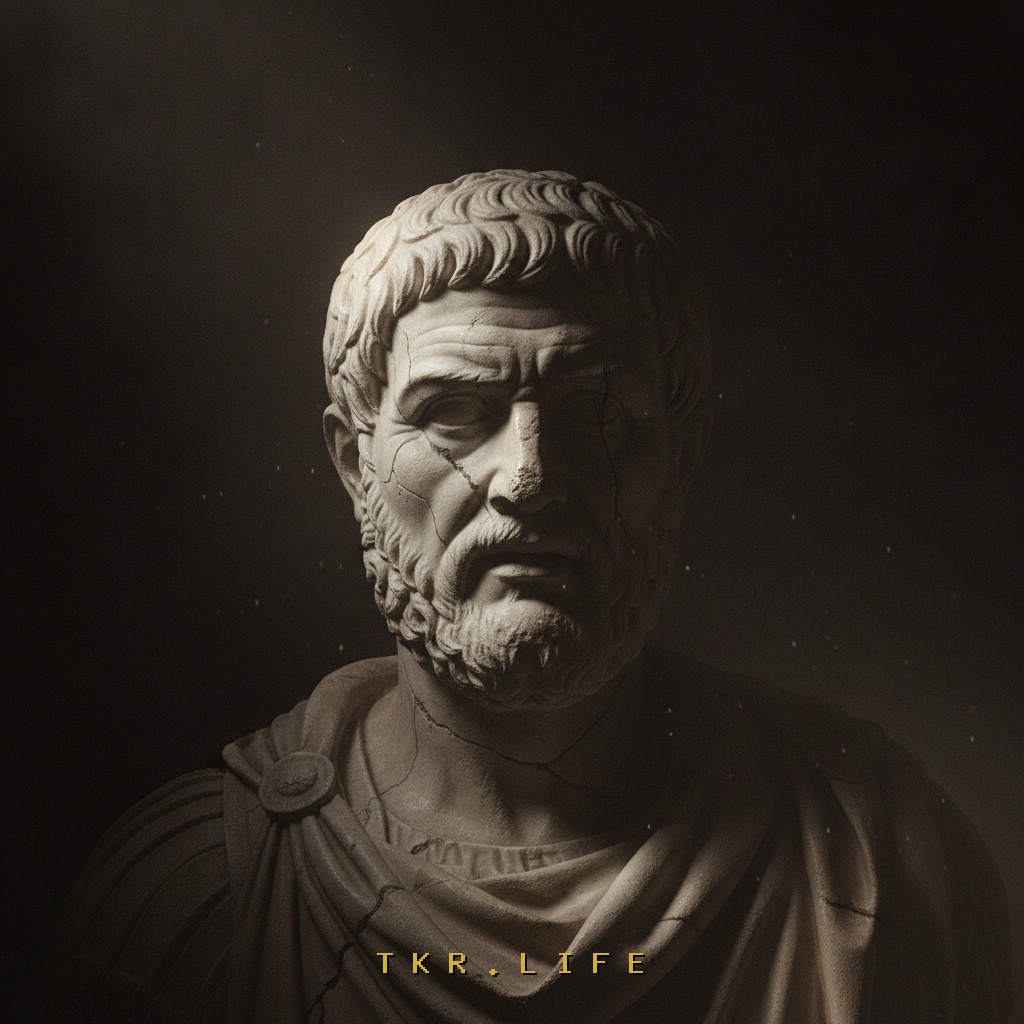
Consider the winter of 173 AD. We find the ruler of the known world not amidst the marble colonnades of the Palatine Hill, nor surrounded by the fawning rhetoricians of Rome, but stationed on the frozen, disease-choked marshes of the northern frontier at Carnuntum, along the Danube.
Marcus Aurelius Antoninus was an aging man, plagued by chronic respiratory illness, spitting blood, his joints seized by arthritis, and his mind carrying the catastrophic burden of the Antonine Plague, which was decimating the Roman population at a rate of two thousand corpses a day in the capital alone. The treasury was empty; he had been forced to auction off the imperial silks, the gold tableware, and the crown jewels in Trajan’s Forum simply to hire auxiliary mercenaries. North of the river, eight Germanic tribes—the Marcomanni, the Quadi, the Sarmatians—had breached the limes, slaughtering legions and pushing terror toward the heart of the empire.
It was in this precise furnace—surrounded by the screams of wounded legionnaires, the reek of gangrene, the biting Pannonian frost, and the imminent threat of imperial collapse—that Marcus Aurelius dipped his reed pen into ink by the flicker of tallow candles and wrote the second book of his private journal:
“When you wake up in the morning, tell yourself: The people I deal with today will be meddling, ungrateful, arrogant, dishonest, jealous, and surly. They are like this because they cannot distinguish good from evil. But I have seen the beauty of good, and the ugliness of evil…”
Notice the absolute absence of self-pity. Notice the unadorned, diamond-sharp lucidity of his prose. The *Meditations* are not the musings of a retired academic sitting in a sunlit atrium; they are the field notes of a man under terminal geopolitical and physical strain. Had Marcus lived in uninterrupted peace, his philosophy would have likely decayed into the decorative pedantry of second-century Roman sophists. Instead, the crushing weight of the Danube frontier forced every drop of romantic self-indulgence out of his system. The strain stripped his vision down to its bare, indestructible skeleton: duty, mortality, present action, and the governance of his own *prohairesis* (the faculty of choice).
He did not attain that clarity and then march to the frontier. The frontier exerted the pressure, and Marcus Aurelius transmuted the pressure into an immortal lens of perception.
CHAPTER III: The Biological Ledger & The Hidden Tax of Hesitation
The neurobiology of the uncommitted mind is an engine of self-destruction. When you oscillate in hesitation, your brain’s Default Mode Network (DMN)—the neural circuitry responsible for self-referential thought, social comparison, and temporal projection—runs wild. In the absence of an immediate, demanding objective, the DMN manufactures an infinite hall of mirrors: Am I ready? What will they think? What if the economic conditions shift? Is this my authentic calling?
This internal rumination carries an exorbitant metabolic cost. Your brain accounts for roughly 2% of your body mass but consumes over 20% of your resting metabolic energy. When you burn this glycogen on speculative dread, you enter a state of chronic, low-grade allostatic load. Your cortisol levels elevate slightly, your vagal tone degrades, your sleep architecture fragments, and yet, zero external work has been performed. You are exhausted from a battle that occurred entirely within your own skull.
Now observe what occurs under acute, sovereign strain:
- The Attentional Funnel: As task difficulty spikes, the brain’s salience network immediately suppresses the Default Mode Network. The locus coeruleus releases norepinephrine, dilating pupils, sharpening visual acuity, and locking your sensory processing exclusively onto task-relevant stimuli.
- The Elimination of Choice Fatigue: In comfort, you are paralyzed by the ‘tyranny of the optional.’ Under heavy load, your options narrow to binary variables: carry the load or be crushed by it. This narrowing of the field is not a restriction; it is the ultimate liberation.
- Dopaminergic Re-anchoring: The brain stops seeking cheap, ambient dopamine hits (notifications, sugar, novelty) and aligns its neurochemical reward architecture entirely with the incremental completion of the immediate friction point.
Hesitation is not safety; it is a compounded interest loan on your mortality, and the interest rate is your vitality. Every hour you spend trying to “feel clear” before stepping into the arena is an hour subtracted from your biological runway. The clock does not negotiate. The ledger is immutable. When you subject yourself to deliberate strain, you stop paying the tax of hesitation and start accumulating the capital of direct knowledge.
CHAPTER IV: Modern Sedation vs Sovereign Output
The modern socioeconomic apparatus is configured with exquisite malice: it is designed to eliminate all physical and structural strain while maximizing superficial, neurochemical irritation. You live in a temperature-controlled terrarium, cushioned by hyper-palatable calories delivered to your threshold, surrounded by interfaces optimized by world-class behavioral engineers to keep your dopamine circuits twitching in a state of perpetually unsatisfied agitation.
This environment produces what can only be termed soft psychosis. The modern citizen confuses agitation with exertion. You spend eight hours swiping through algorithmic outrage, answering passive-aggressive emails, and tracking simulated crises on screens, collapsing into bed at night convinced that you have lived a day of intense strain. You have not.
You have experienced ambient noise, not structural load.
Ambient noise diffuses the spirit; structural load integrates it. Ambient noise makes you irritable, scattered, and blind. Structural load makes you quiet, lethal, and clear. Society incentivizes your sedation because an unstrained, agitated population is the most reliably predictable consumer base in human history. A human being who lacks the clarity forged by genuine friction is perpetually dependent on external guidance: external experts to tell them what to believe, external algorithms to tell them what to crave, and external pharmaceuticals to dampen the phantom anxiety born of their own unused capacity.
To reject this architecture is not an act of wellness; it is a declaration of asymmetrical warfare against cultural entropy. You must become hungry for the very friction the world tries to engineer out of existence. You must seek the heavy bar, the difficult manuscript, the terrifying conversation, the complex problem that resists easy categorization. That is where your sight is returned to you.
CHAPTER V: The 5 Sovereign Battle Protocols for Today
These are not suggestions. These are non-negotiable rules of engagement designed to introduce acute, constructive strain into your operational rhythm over the next twelve hours. Execute them with cold, military fidelity.
1. The Zero-Buffer Deadline (Artificial Compression)
Take the primary cognitive task that has been lingering on your desk for days—the document you intend to write, the strategy you need to formalize, the financial model you need to audit. Cut the allotted time in half. If you planned for four hours, you have two. If you planned for two hours, you have sixty minutes. Sit down, eliminate all secondary displays, and begin. The artificial terror of the compressed horizon forces your brain to immediately abandon ornamental prose, frivolous formatting, and obsessive second-guessing. Under this specific strain, the core signal emerges effortlessly because you have no time to tolerate the noise.
2. The Somatic Shock Threshold
Before you engage your highest-leverage intellectual work today, place your body under acute, undeniable physical resistance. Not a leisurely stroll. A sprint protocol until your lungs burn, a maximal deadlift, a freezing water immersion that triggers the immediate mammalian gasping reflex. Force your nervous system to confront visceral, physiological friction. Why? Because the body sets the baseline for the mind. When you willingly endure physical strain and master your panic in the flesh, the petty intellectual anxieties of your workday are immediately contextualized down to their true, insignificant proportions.
3. The Binary Cull
Audit your task list right now. Strip it down to two vectors: load-bearing and ornamental. A load-bearing task is one whose failure causes structural collapse; an ornamental task is one you do to feel productive without risking failure. Ruthlessly delete or delegate every ornamental item today. Confine yourself entirely to the load-bearing work. The friction of confronting the single task that actually moves the needle—and which you have been actively avoiding—will generate immediate psychological clarity.
4. The Refusal of Hedonic Micro-Bribes
Identify the precise moment during your work when the strain becomes uncomfortable—the moment where the problem gets dense, the code fails to compile, or the prose turns clumsy. This is the inflection point where you routinely reach for your phone, open a browser tab, or get up to check the refrigerator. Freeze in that exact second. Do not touch the pacifier. Sit in the discomfort of the unresolved tension for three full minutes without moving a muscle. The clarity you seek is hidden on the other side of that micro-withdrawal. Stare at the resistance until it yields to you.
5. The Irreversible External Stake
Internal motivation is fragile; external consequences are relentless. If you are wavering on a decision or a major deliverable, create external strain within the next sixty minutes. Send an email to your client, your board, or your team stating: “The draft will be in your inbox by 5:00 PM today; if it is not, hold me fully accountable.” When you tie your reputation to an uncompromising timeline, ambiguity vanishes. The strain of exposure vaporizes hesitation like morning mist before an open flame.
CHAPTER VI: The Evening Ledger & Mental Audit
When the sun retreats and the operational theater closes, do not collapse into mindless entertainment. Sit alone in a room without artificial light or screens. Take a physical notebook. Confront these four questions with the clinical detachment of a coroner performing an autopsy on your day:
- Where did I mistake ambient agitation for sovereign strain today? (Did I waste my energy on social friction and digital trivia, or did I voluntarily place my shoulder against a load-bearing stone?)
- What illusion did the resistance reveal to me? (When the work grew heavy, what lies about my competence, my discipline, or my priorities were instantly stripped away?)
- At what point did I reach for comfort, and what did that comfort cost my trajectory? (Trace the exact moment of cowardice. Name it. Record the price paid in lost momentum.)
- If tomorrow morning mirrors today’s operational discipline, does my ultimate vision advance or rot? (Strip away your self-forgiving narratives. Look at the balance sheet of the last twelve hours and pass sovereign judgment.)
EPILOGUE: Closing Conviction
The universe does not care about your potential. Unexpressed potential is merely the flattering title that cowards give to their unspent days. The earth is full of dead men who spent seven decades waiting for the clouds to part, waiting for certainty, waiting for the path to reveal itself before they took their first heavy, agonizing step.
The clouds do not part for observers. They part for those who climb the mountain in the storm.
Stop praying for lightness. Stop petitioning the cosmos for a calm life, an easy path, or a tranquil mind that has not earned its peace. Tranquility without strain is not wisdom; it is merely the stupor of an animal in a zoo. The clarity you lust after is sitting on the other side of the fire you are currently dodging.
Stand up. Pull the weight onto your spine. Lean directly into the tooth of the wind, and let the strain cut your sight down to bone.