PROLOGUE: The Sovereign Wake-Up Call
Your pulse is already slower than it was at dawn, and with that microscopic deceleration, your claim to this day has begun to liquefy. Look at your hands. Turn them over. Beneath the dermis, an irrecoverable combustion is taking place: ATP spent, telomeres shortened, minutes of biological viability burned off like kerosene in an open draft. The room you inhabit is warm. The ambient air is climate-regulated. The surface beneath you cushions your spine, and precisely because your skin is not in distress, your consciousness has begun to drift into a state of vegetative amnesty.
This is the silent catastrophe of modern existence. You mistake physical safety for existential arrival. You interpret the absence of pain as an invitation to slacken your jaw, rest your shoulders, and recline your intent. But reality does not negotiate with your upholstery. While you bask in the tranquilizing hum of modern domesticity, your allotted daylight is vanishing into the ledger of the dead. Comfort is not a neutral pasture where the spirit recuperates; it is an active solvent. It gets between your fingers and the weapon of your intent, oiling the hilt until the blade slides out of your grasp without a sound.
CHAPTER I: The Anatomy of the Signal
To declare that comfort loosens your grip on purpose is not to utter an aesthetic preference; it is to state a mechanical truth of human psychology. Purpose is not an ethereal concept, an emotional frequency, or a poetic aspiration etched into a journal. In the physical realm, purpose is an isometric contraction of the will. It is the conscious, sustained exertion of force against the natural entropy of the universe. To hold a purpose requires the same metabolic and psychological strain as carrying an iron beam uphill in driving sleet. It demands tension.
What, then, does comfort do? Comfort introduces the lethal suggestion that the beam can be set down without consequence. It whispers that the tension is optional. The moment you cross the threshold from necessary physical recovery into gratuitous, ambient comfort, your nervous system downshifts. The internal alarm that monitors temporal scarcity is silenced. You enter an illusion of timelessness.
“A man who spends his days seeking shelter from all strain eventually forgets how to hold anything that bears weight. When destiny asks him to carry his share, his hands have turned to tallow.”
The drift is almost imperceptible. You do not wake up one morning and consciously renounce your magnum opus, your duty to your lineage, or your pursuit of mastery. Instead, you introduce small, lubricated conveniences into your perimeter. You choose the padded chair over the bench; you choose the heated cabin over the brisk wind; you choose the dopamine stream of an algorithmic feed over the silent, violent labor of deep synthesis. With each concession, your hand opens a millimeter. Your fingers relax their curl. You still believe you possess the purpose because you can still see it lying nearby on the floor—yet you are no longer holding it. You are merely looking at it from the couch, an amputee admiring an old sword.
CHAPTER II: The Historical Crucible: The Mud of Carnuntum
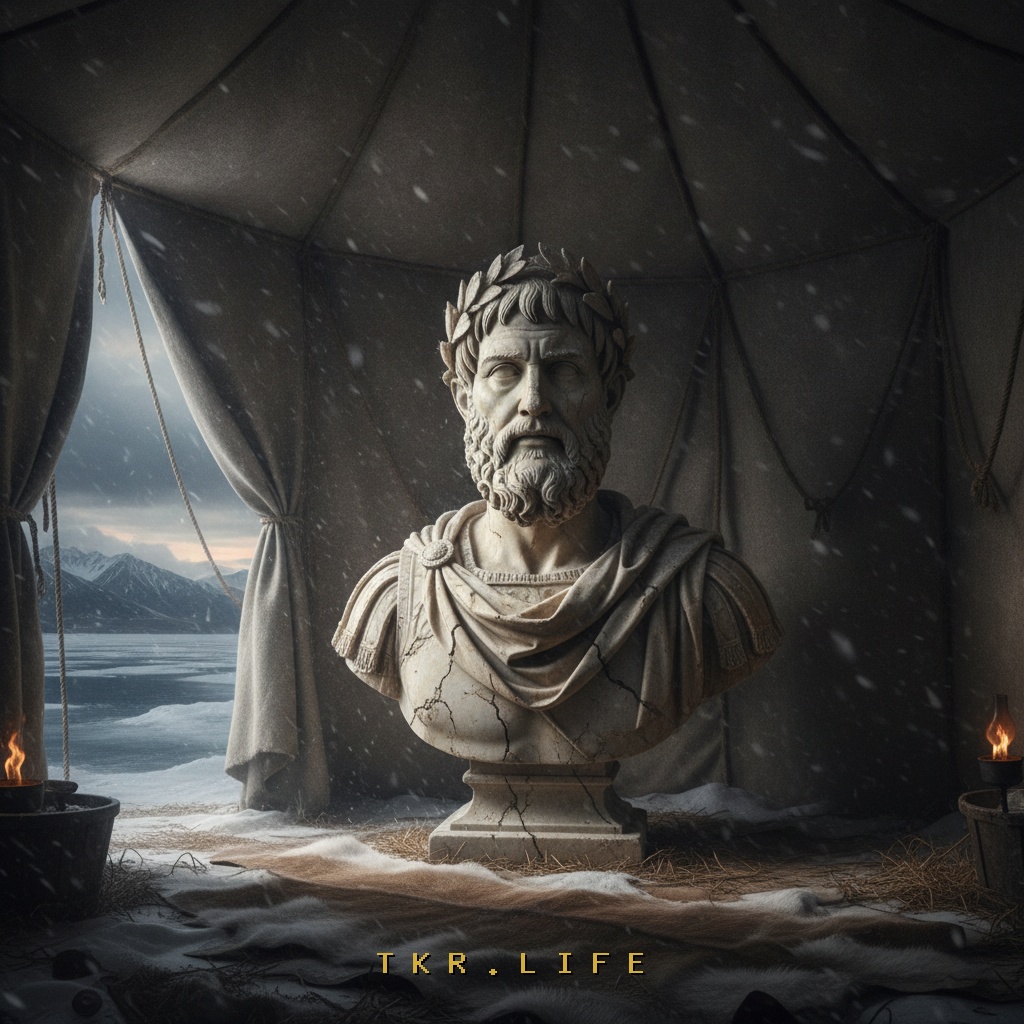
In the bitter winter of 174 AD, the most powerful man in the Mediterranean basin did not sleep on Egyptian cotton or stroll through the sun-drenched peristyles of the Palatine Hill. Marcus Aurelius Antoninus sat in a wind-scoured leather tent on the banks of the frozen Danube, at the frontier outpost of Carnuntum. His body was failing. Chronic chest pains racked his frame; his lungs rattled with blood; the imperial court physicians were hundreds of leagues away behind fortified, heated walls. Outside his canvas flap, the Marcomanni and the Quadi—tribes fighting with desperate, feral fury—threatened to tear the Roman frontier to threads.
Marcus possessed the legal authority to summon every luxury known to human civilization to his bedside. He could have retreated to an imperial villa in Baiae, surrounded by warm thermal baths, vintage falernian wine, and silk-robed servants shielding him from the draft. Had he done so, the Senate would have nodded in deferential approval. Yet he stayed in the mud. Why?
Because he understood with terrifying lucidity that luxury is the embalming fluid of sovereign agency. In his private journal, penned not for an audience but as a whip against his own flesh, he repeatedly wrestled with the seductive terror of the warm bed. When the dawn broke gray and freezing over the Germanic forests, Marcus forced himself upright with a brutal self-interrogation: Was he made to bake under blankets, or was he made to do the work of a human being? He knew that if he yielded to the animal desire for heat and relief, the emperor would remain, but the philosopher-king would dissolve. The discipline required to hold the imperium together resided not in his decrees, but in his refusal to let his physical comfort dictate his operational boundary.
By denying his biology the luxury of collapse, Marcus maintained an iron grip upon his mandate. The cold kept his cognitive edges razor-sharp. The absence of ease forced his mind to locate its sanctuary entirely within the inner citadel of the soul, rather than within the external conditions of his campsite. He did not defeat the northern tribes through superior barbarian savagery; he defeated them because his grip on his imperial purpose was tighter than their grip on survival.
CHAPTER III: The Biological Ledger & The Hidden Tax of Hesitation
Consider the thermodynamic reality of your brain. The human organ of thought is an expensive, hyper-caloric engine that evolved under severe biological scarcity. Its ancient baseline programming is entirely conservative: survive by expending the absolute minimum quantity of energy necessary to reproduce and secure caloric intake. The brain is, by evolutionary default, a comfort-seeking machine.
When you present this paleolithic instrument with the infinite, frictionless conveniences of modern civilization, a profound neurological corruption occurs. When you eliminate all physical and cognitive resistance from your immediate environment:
- The Hedonic Set-Point Collapses: What once served as an extraordinary privilege becomes your baseline entitlement. The threshold of effort required to trigger dopamine release skyrockets. Ordinary, sustained, non-entertaining labor begins to register in your limbic system as intolerable physical torment.
- The Grip Reflex Atrophies: Executive function resides within the prefrontal cortex—specifically in the structures that govern effortful control and long-range inhibition. When comfort removes the necessity of regular, grinding friction, these neural pathways degrade through lack of use. You become neurologically fragile, incapable of sustaining focus past the first symptom of fatigue.
- The Emergence of Temporal Debt: Every minute spent “easing into” your work, every hour lost to comfortable hesitation, is not simply zero-progress time; it is negative equity. You are burning your most potent cognitive daylight—the narrow 4-to-6 hour biological window of peak neurochemical clarity—on activities that require zero metabolic investment.
Hesitation is not an innocent pause; it is the compound interest of cowardice. You tell yourself that you are gathering strength, that you are waiting for optimal conditions, that you are “charging your battery.” This is a neurological lie. You are not charging; you are grounding the current out into the dirt. Energy is generated through kinetic engagement with resistance, not through prolonged immersion in thermal ease.
CHAPTER IV: Modern Sedation vs. Sovereign Output
Look beyond your immediate room and analyze the civilizational apparatus constructed around you. You are enveloped in a multi-trillion-dollar economic machine whose sole, unified objective is to convert your active human will into passive, monetizable compliance. The modern empire does not use iron shackles to pacify its subjects; it uses frictionless delivery systems, infinite algorithmic feeds, memory-foam mattresses, and ambient noise-canceling headphones.
This is the doctrine of Modern Sedation. Society incentivizes you to be comfortable because a comfortable human is predictable, sedentary, and easily governed by their impulses. The person who cannot tolerate twenty minutes of unbroken silence without checking a screen is not a sovereign agent; they are a behavioral livestock unit. Their attention is harvested, bundled, and sold to the highest bidder while they sit inside an air-conditioned room feeling safe.
Sovereign output, by contrast, is intrinsically violent toward comfort. To produce work of enduring, undeniable weight requires that you declare an aesthetic and physical war on ease. The great works of literature, engineering, statesmanship, and philosophy were not hammered out in the spaces between comfortable distractions; they were dragged out of the dark through prolonged, agonizing confrontations with boredom, cognitive strain, and biological resistance.
If your daily environment is engineered to eliminate all physical friction, you will inevitably seek psychological friction in manufactured outrage, trivial drama, and digital hysteria. You must inverse this architecture. Strip away the ambient sedation. Re-introduce deliberate, conscious coldness into your environment. When you sever the IV drip of effortless micro-comforts, your attention stops bleeding into the digital ether and gathers back into a lethal, concentrated beam.
CHAPTER V: The 5 Sovereign Battle Protocols for Today
Abstract philosophy without tactical operationalization is merely intellectual masturbation. For the next twelve hours, you will execute these five non-negotiable protocols to rip your hand free from the sedative trap of ease and re-establish a white-knuckle grip upon your core mandate.
1. The Protocol of Cold Friction (Zero Warm-Up Latency)
When you sit down to execute your most vital intellectual or physical task today, banish the ritual of “preparing to begin.” Do not adjust the lighting, do not fetch a secondary beverage, do not queue up the perfect playlist, and do not spend ten minutes clearing your desk. Plunge immediately into the most abrasive, technically difficult component of the task cold. Treat the discomfort of beginning without momentum as the precise tax required to prove you are awake.
2. The Anti-Upholstery Mandate
Physical posture dictates cognitive vigilance. For the next four hours of your primary work block, eliminate all ergonomic indulgence. Work standing, or utilize a flat, unyielding wooden chair. Keep your feet planted firmly on the floor and your spine self-supported. If your body is resting in an approximation of a reclined sleep posture, your prefrontal cortex will execute its duties with the urgency of a sleeping animal. Deny the body its cushion, and the mind will remain deployed.
3. The Fast from Digital Analgesics
For the remainder of this sunlight window, silence every notification and isolate your working terminal from all consumer platforms. If you encounter a moment of mental blockage or frustration—the exact instant where your hand instinctively reaches for the phone to escape the feeling of cognitive inadequacy—freeze. Stare directly at the wall or the screen for two full minutes in absolute silence. Ingest the friction whole. Do not reach for the digital pacifier.
4. The Heavy-Load SPRINT (90 Minutes of Deep Immersion)
Select the single objective you have been deferring under the fraudulent excuse that you “need a clear block of uninterrupted time.” Carve out precisely ninety minutes. Close the door. Set a countdown timer facing away from your eyes. Work on that single problem with the ferocious, tunnel-visioned intensity of a prisoner tunneling through concrete. Do not stand up until the timer sounds, regardless of how aggressively the itch of boredom strikes.
5. Deliberate Physical Scarcity
Introduce an intentional physical deprivation into the middle of your day. Delay your next meal by two hours past the point of initial hunger, or drink only plain water while working through a complex problem, or take your afternoon shower under pure, unmitigated cold water. Remind your animal nervous system that physical comfort is not an entitlement, but a luxury you can strip away at will without shattering your internal composure.
CHAPTER VI: The Evening Ledger & Mental Audit
When the sun drops below the horizon and the machinery of the day winds down, the world will invite you to sink once more into effortless consumption. Resist it for twenty minutes. Sit alone in a room without a screen, with nothing but a pen and an unlined ledger. Conduct this quiet, brutal post-mortem on your hours before sleep claims you.
- Where did I lubricate my own surrender today? Identify the exact hour and circumstance where you chose ease over the sharper, more demanding path. Name the micro-compromise without wrapping it in defensive justifications.
- Did I hold the purpose, or did I merely talk about it? Look at your actual physical outputs from today—the lines written, the problems solved, the discipline maintained. Did you move the iron, or did you spend your daylight admiring the blueprint?
- What discomfort did I run from that is currently growing larger in the dark? Every difficult conversation deferred, every technical problem dodged, feeds on your avoidance. Acknowledge what you fled from today, and mark it as the primary target for tomorrow’s dawn.
- If this day were the final sample of my character, would my ancestors recognize me as a sovereign human, or as an overfed pet? Strip away your intentions, your hopes, and your internal excuses. Judge yourself solely on your kinetic footprint over the last twelve hours.
EPILOGUE: Closing Conviction
Your life is not a dress rehearsal taking place in the wings of an imaginary theater. It is unfolding right now, on the main stage, under the merciless glare of real time. Every breath you draw is a breath struck from your total balance. You will never get this morning back. You will never inhabit this specific Tuesday or Thursday again. It is burned, gone, transformed into ash in the fireplace of history.
If you allow comfort to dictate the terms of your existence, you are choosing a soft, slow, and disgraceful suicide of your potential. You will arrive at the terminus of your days with your faculties intact, your skin smooth, your cushions unruffled—and your soul hollowed out by the agonizing realization that you never actually engaged the gears of your life. You avoided the cold, you dodged the mud, you stayed out of the rain, and in doing so, you managed to miss your entire incarnation.
Tighten your grip. Right now. Feel the cold iron of your mandate beneath your fingers. Close your hand until the knuckles go white. Stand up, cast off the blankets of your modern domestic coma, and step out into the wind. You were not engineered to rot in safety. You were forged to conquer the strain.