PROLOGUE: The Sovereign Wake-Up Call
At this precise second, your biological ledger is deducting an unrecoverable balance. Cells are undergoing irreversible senescence; metabolic fuel is being spent; the sun is tracing an unyielding arc across the sky, completely indifferent to your internal negotiations. Yet here you sit, paralyzed by the modern disease of the spectator: the delusion that before you take sovereign action, you must first possess emotional serenity, perfect conviction, and absolute clarity.
You tell yourself that you are waiting for the right moment, for the fog to lift, for the tremor in your gut to stabilize. You believe that one morning you will awaken possessing an immovable, unshakeable confidence, and that upon receiving this divine psychological clearance, you will finally pick up the immense responsibilities you have deferred for months, if not years.
This is a lethal biological and philosophical lie. The mind adrift in low-friction conditions does not cultivate clarity; it breeds phantom terrors. Hesitation does not refine your judgment; it atrophies your will. If you spend your brief, razor-thin existence waiting to feel certain before you move, you will die an untested, fragile theoretician whose life was lived entirely within the vestibule of potential.
Certainty is not an antecedent state of mind. It is a biological and structural consequence. You build certainty through load.
CHAPTER I: The Anatomy of the Signal
Consider the basic mechanics of architecture. When the Romans engineered the great aqueducts and triumphal arches that still pierce the Mediterranean skyline two millennia after the fall of their empire, they did not depend on mortar alone to sustain the span. An arch assembled from dry, precision-cut stones—voussoirs—remains intrinsically unstable during construction. If left unweighted, a sudden shift in wind, a tremor in the earth, or the mere passage of time will cause the segments to slip, buckle, and collapse inward.
It is only when the keystone is driven into the apex and the full, crushing mass of the superstructure is laid upon the arch that the individual stones are forced into absolute, immovable solidarity. The gravity that threatened to destroy the scattered fragments becomes the very force that cements them into an indestructible unit. The arch becomes solid because of the load it bears, not in spite of it.
“The mind adapts and converts to its own purposes the obstacle to our acting. The impediment to action advances action. What stands in the way becomes the way.”
— Marcus Aurelius
The human psyche is governed by an identical structural law. In an unburdened state, the human consciousness is an engine of chaotic entropy. When you hold zero significant stakes, when you avoid the crushing gravity of radical accountability, your mind fractures into endless hypothetical scenarios. You invent anxieties to compensate for the absence of authentic struggle. You mistake neurotic rumination for intellectual depth. You obsess over peripheral doubts because you have not subjected your spine to a weight heavy enough to silence them.
Stoic epistemology recognizes that true conviction—what Zeno of Eleum termed kataleptike phantasia, the firm grasp of reality—is not acquired through passive, cloistered contemplation. It is seized through direct, visceral encounter with necessity. When you deliberately step under an immense load—a high-stakes project, an uncompromising standard of physical discipline, the total financial and moral stewardship of your kin—the luxury of self-doubt is instantly incinerated by metabolic demand.
Under heavy load, the peripheral noise of existence falls away. The brain ceases to debate its own capacity because every available neuron is conscripted into the immediate, non-negotiable imperative of carrying the mass forward. You do not discover how strong you are and then decide to lift; you lift, and the relentless compression of the weight forces your biology to organize itself around survival and triumph.
CHAPTER II: The Historical Crucible
In the brutal winter of 170 AD, on the frozen, mud-choked northern banks of the Danube at Carnuntum, the Roman Empire was hemorrhaging at every seam. The Antonine Plague was depopulating whole provinces, turning legions into ghost divisions and burning through the heart of the Mediterranean economy. Along the frontier, over a dozen Germanic and Sarmatian tribes—the Marcomanni, the Quadi, the Iazyges—smashed through the Roman limes, slaughtering the border garrisons and raiding deep into the Italian peninsula itself.
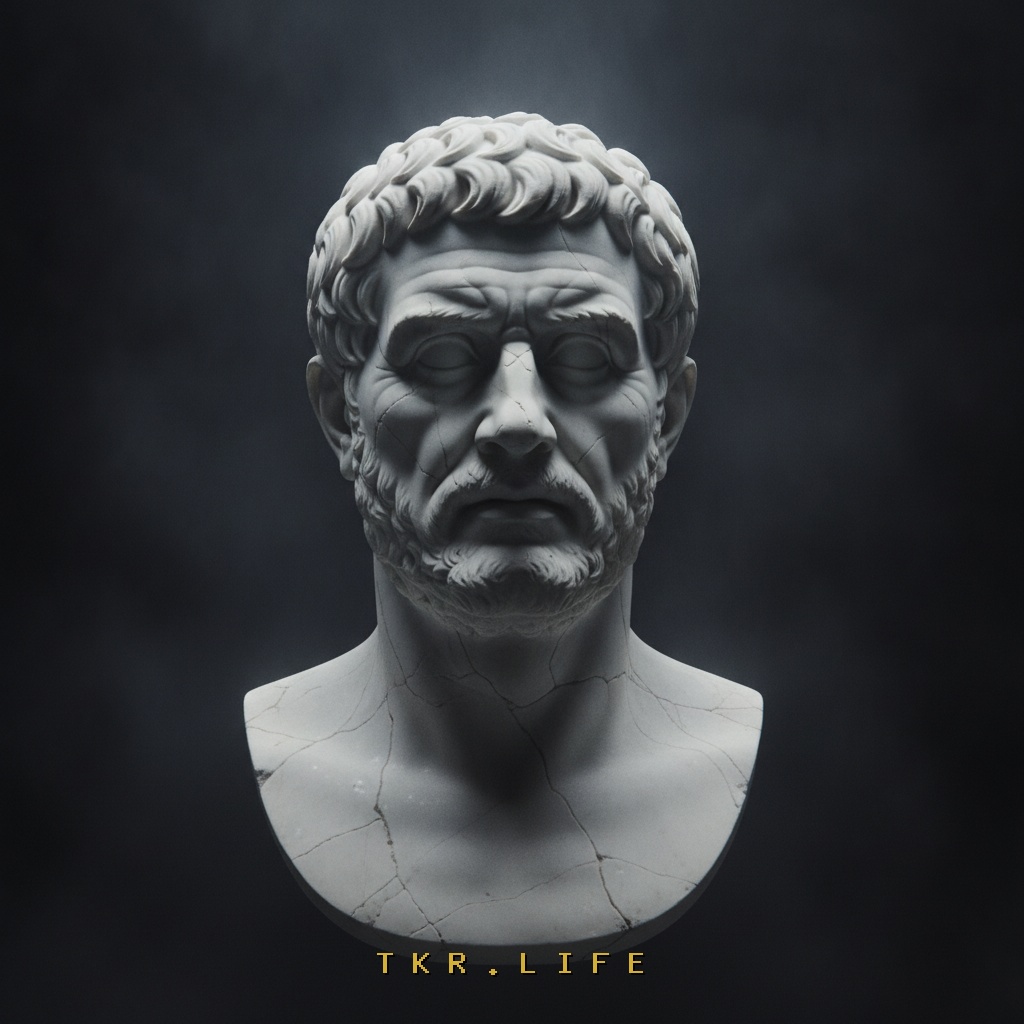
The man who held the apex of this collapsing world was not a bloodthirsty barbarian conqueror. Marcus Aurelius was an ailing, introspective philosopher with chronic respiratory ailments, a fragile digestive system, and a natural inclination toward solitary study. He possessed every intellectual justification to withdraw to the therapeutic baths of Baiae or the sun-drenched palaces of Campania, delegating the butcher’s work to his generals while waiting for geopolitical certainty to return.
Had he waited for certainty, the Western world would have shattered eight centuries early. Marcus did not wait. He understood that an emperor does not earn clarity through retreat; he creates stability by serving as the structural keystone of an empire under siege.
He drained the imperial treasuries. When the gold ran dry, he staged a public auction in the Forum of Trajan, selling off the imperial jewels, the silk tapestries, the golden goblets, and his wife Faustina’s royal vestments to fund the war. He enlisted slaves, gladiators, and city watchmen into the depleted legions. Then, coughing blood into his wool cloak under the leaden skies of the Danube, he rode to the front lines himself.
It was in this frozen hell—surrounded by the screams of wounded men, the stench of gangrene, and the relentless existential pressure of imperial survival—that Marcus penned the private entries that would become the Meditations. You do not read the words of an academic safely insulated behind ivory columns. You read the stripped-down, brutally economic thoughts of a consciousness that has been compressed into diamond purity by the sheer mass of his obligations.
His certainty did not precede the Danube campaign. He built his legendary, monolithic equanimity hour by hour, year by year, beneath the crushing load of eighteen legions and eighty million citizens resting squarely upon his aging shoulders. The load did not break him; the load eliminated his capacity to flinch.
CHAPTER III: The Biological Ledger & The Hidden Tax of Hesitation
Let us dismantle the mechanical cowardice of procrastination using the cold arithmetic of modern neurobiology and temporal physics. Every morning you wake up, your central nervous system commands a finite quantum of cognitive glucose, attentional bandwidth, and neurochemical drive. This is not an infinite well; it is a strictly rationed daily allocation.
When you encounter a demanding obligation and refuse to shoulder it, you believe you are conserving your energy. You assume that by stepping back, scrolling, rationalizing, or planning endlessly, you are preserving your strength for a better day. This is a catastrophic miscalculation of internal resources.
Hesitation is not passive rest; it is an active, metabolically expensive state of hyper-arousal. When you postpone a necessary burden, the brain’s Default Mode Network (DMN) remains locked in an agonizing loop of anticipatory anxiety. The unexecuted task does not vanish; it transforms into an open psychological loop that continuously leaks dopamine and cortisol into your bloodstream. You experience the physical exhaustion of having carried the boulder ten miles without having moved it a single millimeter from where it sits.
- The Drift Tax: An idle will decays at an exponential rate. The longer an individual remains in low-load environments, the more terrifying modest friction appears. What would have been a trivial challenge to your ancestors becomes an existential crisis to your coddled nervous system.
- The Epistemological Paradox: You cannot think your way into a new way of acting; you can only act your way into a new way of thinking. Cognitive certainty without physical kinetic commitment is a chemical impossibility. The proprioceptors and neural circuits responsible for determination are activated exclusively by mechanical strain and tangible consequence.
- Temporal Degradation: Time is not a neutral river. It is a solvent that eats away at human capacity. The hours you spend today trembling before your work are hours that will never be returned to your ledger. You are spending your life buying cheap, counterfeit safety.
The man who hoists the weight immediately terminates the metabolic leak. The moment the barbell leaves the rack, the moment the capital is deployed, the moment the manuscript is begun, the ambiguous anxiety of what might happen is instantly eradicated by the mechanical reality of what is happening. The load forces your biology to integrate. Certainty is the neurochemical peace that arrives when there is no longer any room for retreat.
CHAPTER IV: Modern Sedation vs. Sovereign Output
We are currently enduring the most insidious psychological crisis in human history: the systematic eradication of physical, cognitive, and moral friction. Modern civilization is an optimization machine designed to eliminate load. Everything can be ordered with a thumb-swipe; every biological impulse can be pacified instantly; every synthetic dopamine hit is delivered on demand, without the expenditure of a single calorie or the risk of public failure.
The societal architect does not want you to carry heavy load. A culture of consumerist cattle requires individuals who are anxious, fragmented, easily swayed, and perpetually uncertain of their own strength. When you are kept in a state of frictionless infantility, you are infinitely monetizable. You will purchase endless products to cure the anxiety that is caused solely by your own cowardice. You will consume infinite hours of other men’s achievements through a five-inch glowing pane of glass, desperately seeking the vicarious thrill of victory while your own muscle tissue and resolve atrophy in the dark.
This is the notification trance: a low-grade, constant, digital sedation that convinces you that you are engaging with the world while shielding you from every consequence that makes a man formidable. You accumulate opinions on everything, yet you carry responsibility for nothing. You have transformed yourself into a synthetic spectator.
Sovereign output requires an immediate, violent defection from this digital nursery. You must develop a profound, aristocratic disgust for ease. When you look at an easier path, an automated shortcut, or an opportunity to evade accountability, you must recognize it for what it truly is: a poisoned chalice designed to keep you weak, dependent, and fundamentally uncertain.
The sovereign individual deliberately seeks out the structural pressure points of his life. He looks for where the ceiling is sagging, where the work is terrifying, where the stakes are genuine, and he places his body directly underneath the structural fault lines. He does not ask for ease; he demands the heavy timber, because he knows that the only men who possess genuine authority are those whose bones have calcified under unbearable weight.
CHAPTER V: The 5 Sovereign Battle Protocols for Today
Philosophy divorced from immediate physical execution is nothing more than masturbatory literature. To burn the signal “You build certainty through load” into your central nervous system, you will execute these five protocols across the next twelve hours without deviation, apology, or hesitation.
1. The Protocol of the Keystone
Within ninety minutes of reading this text, identify the single most avoided, heavy, and consequential responsibility currently haunting your life. Do not select a comfortable administrative chore; choose the exact task whose magnitude induces nausea in your throat. Commit yourself irreversibly to it today. Make the phone call, sign the contract, write the first three thousand words, or cut the dead-weight personnel. Do not wait for confidence; force the keystone into place and let the structural load crush your excuses.
2. Bilateral Load Allocation
Uncertainty flourishes in the presence of escape hatches. For every primary objective you pursue today, systematically burn your safety margins. Put non-refundable capital on the line. Announce an uncompromising, immutable deadline to stakeholders whose respect you cannot afford to lose. Place yourself in a scenario where retreat is more socially, financially, or physically humiliating than pushing through the objective. Load requires consequences; eliminate your exit strategies.
3. Metabolic Compression (Temporal Hypoxia)
Select a massive intellectual or operational deliverable that typically takes you four hours of distracted, intermittent labor. Cut the allocated time by fifty percent. Lock yourself in a room, sever all internet connections, kill all notifications, and execute under acute time pressure. When you compress the timeline, you simulate physiological hypoxia. Your brain is stripped of the bandwidth required to question its methods. Speed and heavy resistance will force immediate operational certainty.
4. Surcharge of Trivial Anxieties
Notice the micro-frustrations and small anxieties that have agitated your mind over the past forty-eight hours—petty slights, trivial logistics, minor social friction. Deliberately drown them out by taking on a vastly superior operational burden. When you are carrying a five-hundred-pound squat, you do not feel the fly that lands on your ankle. Surcharge your life with immense responsibility until your minor neuroses are starved of cognitive resources and die from neglect.
5. The Kinematic Metric
Today, you are forbidden from measuring your personal value or readiness by internal sentiment. You will measure your state exclusively through the physical displacement of mass and sovereign output. How many units of work crossed the threshold? How many hours of absolute deep focus were logged? How many pounds were lifted? Emotions are dynamic weather patterns; work completed is monolithic marble. Build your certainty on physical telemetry, never on internal feelings.
CHAPTER VI: The Evening Ledger & Mental Audit
Tonight, before the lights are extinguished and the noise of the day recedes into the dark, you will sit in complete solitude with a notebook and a pen. You will not look at a screen; you will not seek the validation of your peers. You will confront the unyielding mirror of your own conscience and demand answers to these four piercing audits:
- Where did I actively dodge the load today, and what precise lie did my intellect invent to justify my cowardice? (Strip away your self-soothing explanations. Name the exact moment you flinched from the heavy timber and retreated into petty, frictionless tasks).
- In which sector of my work did I wait for the illusion of “readiness” instead of stepping under the weight and forcing certainty to emerge? (Acknowledge the cost of your hesitation in lost momentum, wasted neurochemical energy, and temporal decay).
- Did I act today as an unweighted, vibrating stone that threatens the stability of the entire arch, or did I drive myself into the apex as a keystone of immovable reliability? (Evaluate your impact on your family, your enterprise, and your team. Did your presence absorb pressure, or did you leak panic into the environment?).
- If tomorrow were an exact, immutable carbon copy of my discipline today, would I become a master of reality or a casualty of comfort? (Look at the trajectory of your behavior without romanticizing your potential. Follow the vector to its inescapable mathematical conclusion).
EPILOGUE: Closing Conviction
Look at your hands. Look at your life. The world is full of broken, drifting souls who spend their entire journey crying out for a sign, begging the heavens for certainty, wondering when the fear will dissipate, when the path will become flat, and when the burden will be lifted.
They are blind to the fundamental architecture of existence. The burden is not your punishment; the burden is your salvation.
The universe does not grant certainty to the idle beggar. It grants certainty only to the man whose muscles are trembling under the sheer weight of an absolute commitment, whose spine is compressed by massive duties, and whose boots are planted deeply into the blood and mud of the arena.
Cease praying for a lighter load. Pray for broader shoulders. Stop demanding that the path become clear before you take the stride. Step into the dark with the heaviest mass you can bear, drop your hips, lock your grip, and lift with everything that remains in your marrow.
The fog will clear only when the work is heavy enough to blow it away. Pick up the weight. Now.