PROLOGUE: The Sovereign Wake-Up Call
At this exact second, your cells are metabolizing the finite reserve of energy allocated to your biological tenure on this earth. The clock is not a neutral metric; it is an unblinking auctioneer selling off your remaining vitality in exchange for whatever you are currently choosing to tolerate. Look at your hands. Look at the room around you. The quiet tragedy of human existence is rarely dramatic ruin or catastrophic collapse; it is the silent, pervasive rot of the uncommitted life. You drift through mornings and afternoons under the narcotic assumption that your real life—the serious, formidable, consequential version of your existence—will begin after you have gathered a little more information, established a little more stability, or felt a little more certain.
This is a biological lie. Certainty does not precede consequence; it is forged within the furnace of it. Nature does not waste its precious metabolic capital upgrading an organism that refuses to place itself under mortal necessity. As long as your decisions remain weightless—reversible, buffered by comfort, easily excused, and padded by consensus—your mind and character will remain flaccid, porous, and utterly unformed. You do not discover who you are through introspection in an armchair. You are cast into form only when you step beneath a burden so heavy that dropping it means catastrophe, and carrying it forces every sinew of your soul to calcify into iron.
CHAPTER I: The Anatomy of the Signal
In structural engineering, the fundamental distinction that separates an enduring edifice from a collapsing ruin is the difference between a partition wall and a load-bearing column. A partition wall is an aesthetic convenience. You can assemble it with cheap timber and gypsum; you can knock it down with a sledgehammer on an afternoon whim; you can puncture it, alter it, and remove it without threatening the roof above your head. It bears nothing. It exists merely to divide space and provide the illusion of substance.
The vast majority of human beings organize their entire existence around partition decisions. They debate which diet to pursue, what book to read, which software tool to adopt, or what opinion to broadcast on digital forums. These are drywall choices. They carry no structural liability. If you fail to adhere to them, nothing collapses. If you change your mind tomorrow, your world remains fundamentally intact. Because these decisions carry no weight, they demand no evolutionary adaptation from the nervous system. You can make ten thousand such choices across forty years and remain precisely as fragile, timid, and superficial as you were at twenty.
“A decision is not real until it eliminates the possibility of retreat. Until the bridge behind you is ash, your intellect operates in the mode of an observer, not an architect.”
A weight-bearing decision is qualitatively different. In the architecture of human destiny, a weight-bearing decision is one that redistributes the actual stresses of existence. It is characterized by three non-negotiable attributes: irreversibility, asymmetric liability, and structural consequence.
When you make a weight-bearing decision, you deliberately sever your own escape routes. You stake capital, reputation, time, or physical comfort on an outcome where you alone are the guarantor of solvency. You declare: “If this fails, the ruin is mine; if this stands, it stands because I held the ceiling.” The moment the psyche registers the true gravity of such an act, the evolutionary mechanism awakens. The mind ceases its trivial daydreams. Hesitation is incinerated because hesitation is now unaffordable. The organism undergoes rapid, forced adaptation—not because it desired to grow, but because it had no other choice if it wished to survive the load it voluntarily placed upon its own spine.
CHAPTER II: The Historical Crucible
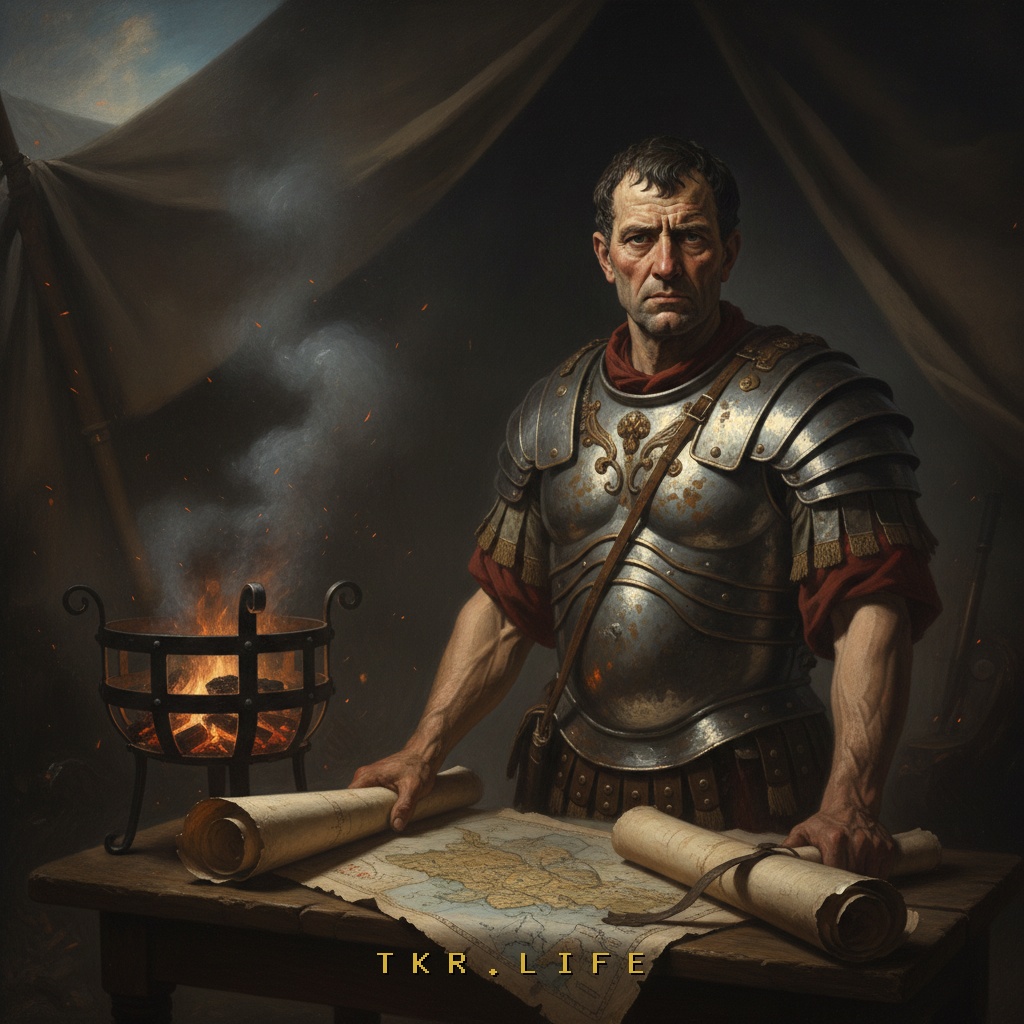
Consider the winter of 175 AD on the freezing mud-flats of Carnuntum, along the Danube frontier. Marcus Aurelius Antoninus—a man whose natural inclinations belonged entirely to the quiet libraries of Athens and the contemplative solitude of the Stoa—had spent nearly a decade living in leather tents amidst the stench of horse sweat, dysentery, and rotting flesh. His body was failing. His chest was racked by chronic respiratory spasms; his stomach could tolerate only minute quantities of crushed theriac; his joints were seized with arthritic agony. He was not an athletic conqueror in the mold of Alexander; he was an aging, sick philosopher who had every rational justification to delegate the barbaric northern wars to his sub-commanders and return to the heated baths and marble halls of Rome.
Then, the catastrophic dispatch arrived from the East. Avidius Cassius, his most brilliant general and the commander of the Syrian legions—the man who held the entire wealth and grain supply of Egypt and the Levant—had revolted. Word had reached Syria that Marcus was dead, and Cassius had immediately seized the purple, commanding the loyalty of seven veteran legions. Rome stood on the razor’s edge of another catastrophic civil war, identical to the ones that had drowned the Republic in patrician blood a century and a half earlier.
In that frozen tent, Marcus faced a decision that carried the absolute weight of Western civilization. A lesser sovereign would have made the frantic, low-weight decisions of a terrified tyrant: issue orders for the immediate slaughter of Cassius’ family in Rome, execute suspected senators, and retreat south to secure personal safety behind the Praetorian Guard. Instead, Marcus absorbed the crushing load of absolute imperial sovereignty onto his solitary shoulders.
He assembled his troops in the mud of the Danube. He did not conceal the rebellion, nor did he rage against Cassius. He addressed his soldiers with terrifying, crystalline composure. He stated plainly that if the empire could be better served by Cassius, he would willingly lay down his life without striking a blow. But if not, he would march east—not to slaughter his fellow citizens, but to capture Cassius alive and forgive him, so that the world might see how a Stoic rules when betrayed.
Marcus made the weight-bearing choice: he refused the easy sedation of paranoid butchery, preserved the integrity of the Roman Senate by forbidding any domestic reprisals against Cassius’ kin, and forced himself to march across the breadth of the empire despite his dying flesh. He bore the consequence of peace, mercy, and unified command when every animal instinct screamed for self-preservation. That decision did not merely preserve the Pax Romana for another generation; it crystallized Marcus Aurelius into the immortal archetype of sovereign virtue. His philosophy was not written in ink; it was hammered into existence under the crushing tonnage of that unhedged command.
CHAPTER III: The Biological Ledger & The Hidden Tax of Hesitation
Modern human beings are afflicted by an insidious delusion: they believe that withholding a decision preserves their options. You tell yourself that by remaining in the doorway—by lingering in a dead relationship, a mediocre career, an uncommitted creative ambition, or a tepid moral stance—you are keeping your possibilities alive. You believe that inaction is free.
This is economic and biological illiteracy. Hesitation is the most expensive transaction an organism can execute. Every day you spend straddling an unresolved crossroad consumes cognitive bandwidth, depletes neurochemical reserves, and generates chronic cortisol exposure. The human brain was engineered to evaluate risk and execute action; it was never designed to hold twenty contradictory hypothetical futures in perpetual suspension. That suspension is what you experience as modern anxiety. Anxiety is not a genetic defect; it is the cognitive smoke produced by a life cluttered with decisions that lack the courage of execution.
| Decision Architecture | Immediate Sensation | Long-Term Biological Consequence |
|---|---|---|
| Drywall (Low-Weight) | Comfort, optionality, low friction | Atrophy of will, identity fragmentation, paralysis |
| Load-Bearing (Heavy) | Terror, acute focus, sovereign weight | Structural evolution, psychological density, clarity |
Consider the temporal arithmetic. If you are thirty-five years old, you have approximately sixteen hundred weeks of conscious daylight remaining on this earth. Half of that will be consumed by basic physiological maintenance: sleep, digestion, hygiene, and transit. That leaves eight hundred weeks of discretionary metabolic agency. When you spend six months agonizing over whether to leave an employer, launch an enterprise, cut out a toxic family tie, or commit wholly to a single craft, you are not “thinking things through.” You are burning fifty weeks of irreplaceable sovereign life to avoid the immediate, cold shock of bearing weight.
The organism adapts to what it is asked to carry. If you ask your intellect to carry nothing more demanding than algorithmic feeds, hedged opinions, and low-stakes pleasantries, it will adapt by becoming thin, easily agitated, and functionally inconsequential. If you want a mind capable of weathering tragedy, commanding respect, and imposing order on chaos, you must systematically feed it problems where the cost of failure is real, personal, and uninsurable.
CHAPTER IV: Modern Sedation vs Sovereign Output
We are living inside the most sophisticated architecture of distraction ever constructed in human history. The digital landscape is not engineered to inform you; it is engineered to domesticate you. It offers you a continuous, synthetic substitute for actual agency. You can experience the chemical high of conflict on social platforms without risking your jaw. You can experience the pseudo-satisfaction of achievement in video games without bleeding for mastery. You can experience the illusion of social standing through digital metrics without ever commanding the respect of an actual human being in the physical world.
This environment produces what can only be termed ontological softness. Modern culture trains you to resent weight. It teaches you that friction is an injustice, that discomfort is an assault, and that the highest virtue is seamless, frictionless consumption. Every app on your phone is designed to eliminate friction—to make purchasing instantaneous, communication effortless, and validation automatic.
The sovereign individual recognizes this sedation for what it is: a soft prison. When you outsource all friction, you outsource the very catalyst that produces human capability. The cultural incentive is to keep you in an infant state: dependent, easily agitated, highly reactive, and perpetually uncommitted. To break this trance, you must consciously and aggressively cultivate weight-bearing responsibility. You must actively search for areas in your work, your relationships, and your interior life where you have been hiding behind consensus, delegation, and deferral—and you must deliberately pull the entire structural load onto your own shoulders.
CHAPTER V: The 5 Sovereign Battle Protocols for Today
Do not close this essay and return to your day as a consumer of philosophical prose. Philosophy that does not alter physical behavior within twelve hours is merely decadent mental entertainment. Execute these five battle protocols between now and the close of your evening ledger.
1. The Rubicon Mandate: Eliminate One Hedged Position
Identify the single decision in your professional or personal life that you have kept in a state of lukewarm “deliberation” for more than thirty days. Today, you cross the river. You either terminate the project completely and delete the files, or you commit total resources to its execution and communicate that commitment to an external party with zero room for retraction. Burn the escape hatch before sundown.
2. The Radical Liability Clause
In your next professional meeting or personal conflict today, voluntarily take 100% of the public blame for an unresolved friction or systemic failure. Do not nuance it. Do not contextualize it. Do not spread the guilt across the team or the circumstances. Say the words: “This is my responsibility. The breakdown occurred under my watch, and the correction is entirely on me.” Feel the physical, heavy drop in your gut as you speak it. That sensation is the weight-bearing column taking the load.
3. The Severance of the Third-Person Shield
Audit your language for the next eight hours. Ban the words “we should,” “someone needs to,” or “it would be good if.” Replace them entirely with first-person, sovereign agency: “I will,” “I have decided,” and “I take the consequence.” If you are not willing to say “I will bear the outcome,” do not speak the thought. Stop hiding inside the anonymous collective.
4. The Physical Tonnage Anchor
Biological softness breeds psychological cowardice. Today, subject your physical vessel to a deliberate, non-negotiable weight. Go to a barbell, a hill, or a stretch of pavement. Select a load or an exertion profile that your mind insists is excessive. Stand beneath it. Do not listen to the internal voice that petitions for moderation. Remind your nervous system through physical strain that you are an organism that operates under load, not an ornament to be protected from the elements.
5. The Silence Protocol
When you make your consequential decisions today, tell no one on social media. Announce nothing. Do not seek the cheap, front-loaded dopamine of public declarations. The true sovereign carries the heaviest burdens in terrifying silence. Let the consequences of your execution speak to the world; keep the labor locked inside your own internal temple.
CHAPTER VI: The Evening Ledger & Mental Audit
When the sun has abandoned the sky and the noise of the commercial world retreats, you must sit alone in a room without screens, without music, and without narcotics. Take a blank sheet of paper and sit with these four piercing questions. Answer them with the brutal honesty of a man speaking to his executioner:
- What choice did I dodge today by pretending I needed more information? (Name the specific cowardice. Name the fear that wore the mask of research.)
- Where did I lean on another human being or circumstance to absorb a blow that belonged to me? (Identify where you shifted the weight to avoid the bruise.)
- If my entire character was judged solely by the irreversibility of my choices today, would I be counted as an architect or as a tenant?
- What is the heaviest decision I am currently terrified of making, and what will it cost my future self if I refuse to bear it before this week ends?
EPILOGUE: Closing Conviction
You were not engineered to pass through this world without leaving a scar upon reality. You were not granted biological breath merely to metabolize nutrients, accumulate digital points, and decay gracefully into a quiet grave. The universe does not yield its deeper secrets to spectators who watch from the grandstands of life, insulated from consequence and terrified of skin in the game.
The men and women who shaped the earth—who carved civilizations out of wilderness, who stared down tyrannical assemblies, who built philosophies capable of surviving two thousand years of barbarian sieges—were forged in only one way: they volunteered to carry the load. They stepped out from the sheltering herd. They took the unhedged bet. They placed the weight of entire cities, families, principles, and empires onto their own finite collarbones and refused to bend.
Your life is slipping through your fingers while you negotiate with petty comforts. Stop waiting for safety. Stop looking for consensus. The ceiling is sagging, the hours are vanishing, and the world is desperate for individuals who have the stomach to govern themselves under real consequence. Find the heaviest decision currently facing you. Walk up to it. Place your shoulders beneath it. And lift.