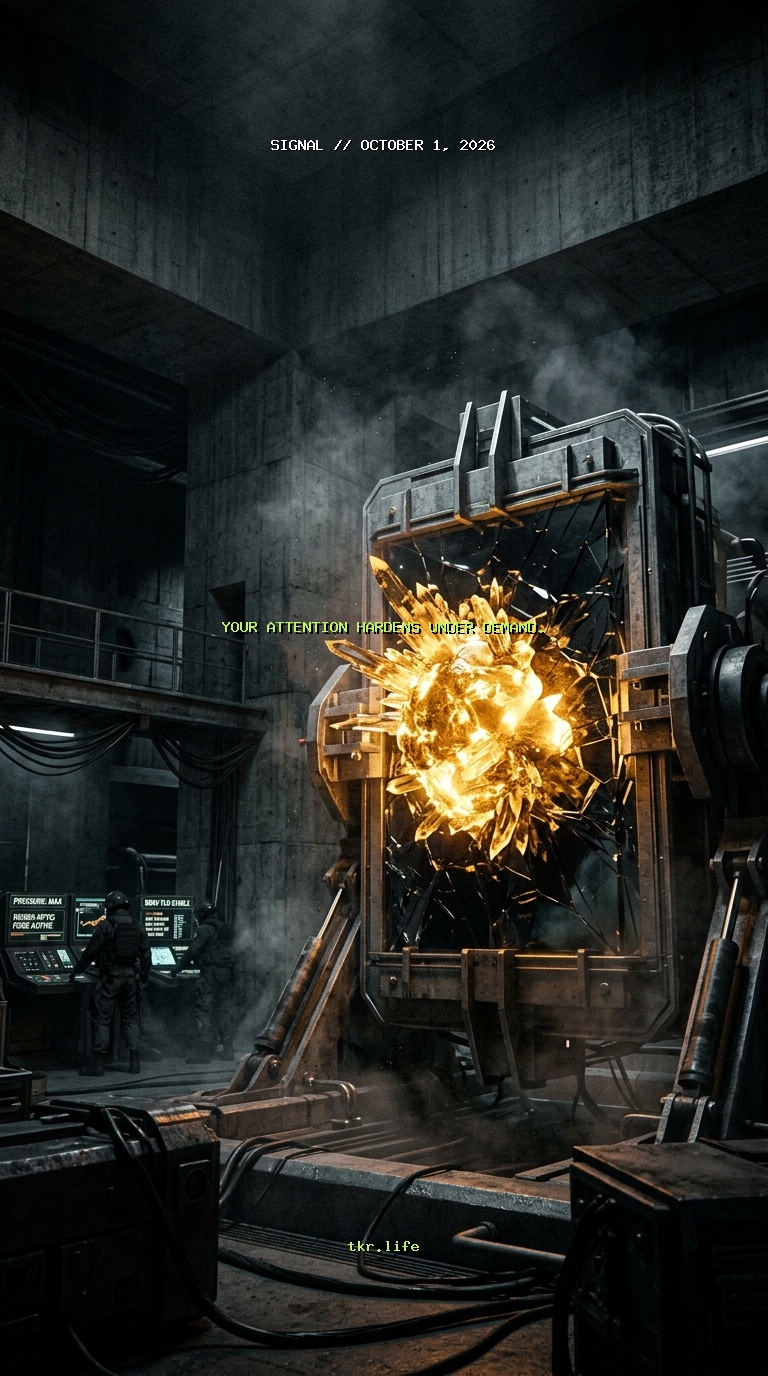
You operate under the pathetic delusion that your mind requires sanctuary to achieve depth. You wait for ambient silence, pristine ergonomics, and the clearing of life’s chaotic ledger before you expect yourself to focus. This is a structural misreading of your biological architecture. Attention is not a fragile, hothouse orchid that withers under friction; it is a non-Newtonian faculty. Under negligible resistance, it behaves like water—slipping through your fingers, pooling into trivia, and evaporating into ambient noise. It is only when catastrophic, uncompromising force is applied that its lattice locks into steel.
The Sloth of Protected Consciousness
Consider the architecture of your average day. You insulate yourself from severe consequences, delegate cognitive friction to algorithms, and mistake this absence of tension for peace. Yet within this low-stakes vacuum, your capacity for sustained awareness does not regenerate—it liquefies. A mind shielded from rigorous, high-consequence requirements begins to fracture under the weight of its own boredom. You open tabs, check notifications, and drift through half-formed thoughts because nothing immediate threatens you if you look away.
The human animal was never engineered to maintain sovereign focus in an arena devoid of stakes. Your ancestral neurology sharpened in an environment where distraction carried the immediate penalty of death or starvation. When you remove ruthless necessity from your daily output, your prefrontal cortex downregulates. It does not consolidate power; it disperses it across meaningless stimuli. You do not suffer from an attention deficit; you suffer from an absence of legitimate consequence.
The Architecture of the Crucible
Cognitive hardening requires an uncompromising anvil. When you impose aggressive deadlines, deep conceptual complexity, and absolute exposure to failure, the extraneous noise of the world is violently excised. There is no time to ponder existential doubt or indulge trivial impulses when the load above your head requires every joule of metabolic energy simply to remain upright.
This is where true sovereignty is forged. Deep concentration is not an interior state of serene contemplation; it is the violent channeling of biological drive into an immovable focal point. The ticking clock of your mortal life is not a metaphor. You have roughly four thousand weeks of metabolic output if you are genetically fortunate, and a vast portion of that capital has already turned to ash. To approach your remaining hours with soft, porous attention is a form of passive suicide.
The Daily Cognitive Audit
Conduct this reality check before this day concludes:
- Examine the stakes: What is the singular task on your docket today that carries real, unhedged consequence if performed poorly? If you cannot identify one, you are merely running out the clock.
- Constrict the margin: Halve the time you have allotted for your most intellectually demanding task. Strip away the buffer that invites mental wandering.
- Eliminate the exit ramps: Remove the comfort of the fallback option. When focus becomes the only instrument capable of averting disaster, your mind will snap into alignment with brutal, terrifying clarity.
Stop curating the perfect conditions for your mind to behave. Throw yourself into the deep end of non-negotiable responsibility. Demand more from your intellect than it believes it can supply, and watch how swiftly the scattered dust of your attention solidifies into armor.