PROLOGUE: The Sovereign Wake-Up Call
Your biology is not an open-ended lease; it is a rapid, non-negotiable foreclosure. As you read these words, metabolic waste accumulates in your cellular matrix, telomeres trim imperceptibly shorter, and the cold arithmetic of your remaining days contracts. Most men exist under the childish hallucination that their daily concessions are weightless—that a sluggish morning, an hour bartered away to algorithmic triviality, or an unfulfilled pledge to the self simply vanishes into the ether of the past, leaving no scar upon the ledger of their soul.
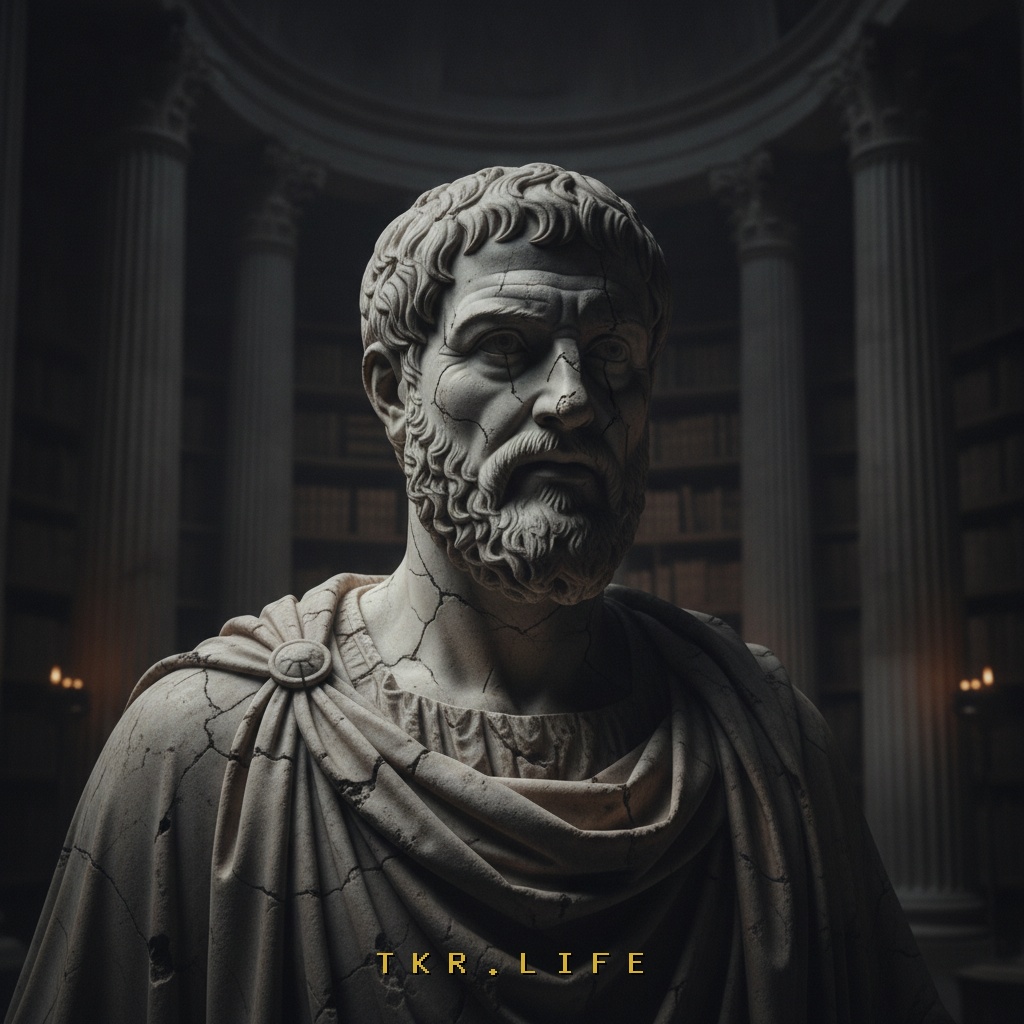
This is a catastrophic error in basic physics. Time does not erase; it casts into concrete. You are not writing your existence on water; you are chiseling it into bedrock. Every single micro-behavior you tolerate, every pathetic compromise you justify in the dark corners of an ordinary afternoon, does not disappear. It hardens. It forms a load-bearing column within your psychological architecture. When crisis eventually strikes—and crisis is an absolute certainty—you will not rise to the theoretical heights of your dormant potential. You will collapse onto the brittle, rotten foundation your daily habits have quietly erected.
CHAPTER I: The Anatomy of the Signal
To understand the signal—Your habits echo structurally—you must first abandon the pedestrian view of human behavior peddled by modern pop-psychology. The mediocre mind views a habit as a behavioral accessory, like an article of clothing to be put on or cast aside at will. It treats waking up late, doom-scrolling, or deferring intellectual labor as merely “suboptimal routines” that can be reversed next Monday with a surge of enthusiasm.
The ancient Stoics understood reality with far greater ruthlessness. In the physics of the Stoa, particularly as developed by Chrysippus, the universe and the human soul are sustained by tonos—an internal tension, a dynamic coherence that gives form, resilience, and identity to matter. A body without tonos goes slack, rots, and disperses. Your character operates under the exact same law. Every choice you make is not an isolated event; it is an act of structural engineering that alters the tensile strength of your character.
“Look beneath the surface; let not the several quality of a thing nor its worth escape thee.” — Marcus Aurelius
When you yield to sloth, you do not simply fail to produce; you actively recalibrate your baseline of endurance. You train your nervous system to accept fracture under the slightest pressure. A habit is an echo that travels forward in time through the physical and cognitive systems you inhabit. The deferral of a difficult conversation today does not merely delay conflict; it introduces an acoustic dead-zone into your assertiveness, mutating how you negotiate five years from now. The undisciplined calorie, the broken schedule, the soft, forgiving voice of rationalization—these are not fleeting moments. They are the mortar you use to construct the prison cell that will ultimately suffocate your ambition.
CHAPTER II: The Historical Crucible
To witness structural habits forged in fire, cast your gaze toward the sodden, frost-bitten banks of the Danube River in the winter of 174 CE. The Roman Empire was convulsed by the Antonine Plague, an apocalyptic pestilence that decimated one-third of the population. Germanic warbands—the Marcomanni and the Quadi—had shattered the northern frontier, slaughtering legions and penetrating deep into the Italian peninsula. The imperial treasury was empty. Rome itself was gripped by terror.
At the center of this maelstrom stood Marcus Aurelius Antoninus. He was not a natural-born warlord. He was a fragile, bookish man plagued by chronic chest pains, insomnia, and agonizing stomach ulcers. He had every historical and biological excuse to govern from the marble sanctuaries of Baiae or Rome, insulating his failing lungs with Mediterranean warmth while delegating the slaughter to his generals.
Instead, he established his headquarters at Carnuntum, a desolate military outpost on the frozen edge of the known world. For nearly a decade, Marcus lived in a tent of leather and iron, inhaling the stench of wet wool, horse manure, and gangrene. It was not inspiration that kept him standing; it was an uncompromising habit of structural self-examination. In the dead of night, by the flickering light of an oil lamp, wrapped in his coarse military cloak, he opened his personal notebooks—what we now revere as the Meditations.
These entries were not written for publication, nor were they comfortable philosophical treatises. They were visceral, structural hammer-blows striking at his own vulnerabilities. When his weary body screamed for sleep, he reminded himself of the rising sun: “At dawn, when you have trouble getting out of bed, tell yourself: ‘I have to go to work—as a human being. What do I have to complain of, if I’m going to do what I was born for?’” When court politics and the betrayal of Avidius Cassius threatened to embitter his heart, he recalibrated his mental posture: “The people I deal with today will be meddling, ungrateful, arrogant, dishonest, jealous, and surly… None of them can hurt me.”
Marcus understood that if he allowed his habits to slacken for a single week—if he permitted self-pity to seep into his thoughts or luxury to soften his discipline—the structural integrity of the entire Roman world would shatter with him. His daily routines of self-interrogation, rigorous simplicity, and relentless execution of imperial duty were the load-bearing arches supporting civilization against barbarian slaughter. His habits echoed across the centuries because they were built to bear impossible weight.
CHAPTER III: The Biological Ledger & The Hidden Tax of Hesitation
We must strip away sentimentality and examine the merciless mechanics of your biology. The human central nervous system is a relentless optimization engine governed by the laws of neuroplasticity and temporal economics. It does not possess a moral compass; it possesses an efficiency algorithm.
Every time you engage in an action—or succumb to an evasion—the brain reinforces the underlying neural pathways through myelination. Myelin is a lipid-dense sheath that wraps around neuronal axons, accelerating the transmission of electrical impulses. When you execute deep, uncomfortable focus under friction, your brain structurally insulates that pathway, making subsequent executions faster, more automatic, and cognitively cheaper. Conversely, when you hesitate, retreat into cheap distraction, or negotiate with your lower impulses, your brain myelinates the circuitry of surrender.
Consider the biological arithmetic of your daylight:
- The 16-Hour Capital: You possess roughly sixteen waking hours of conscious sovereignty each day. If three of those hours are surrendered to low-friction passivity, you have burned nearly twenty percent of your life’s working capital. Over a single decade, this equals roughly 11,000 hours—an entire lifetime of mastery squandered on digital sludge.
- The Synaptic Pruning of Ambition: Neural circuits that remain unutilized are systematically dismantled through synaptic pruning. If you do not routinely demand immense, crushing intellectual and physical exertion from yourself, your biology concludes that those capacities are metabolically redundant and quietly eliminates the machinery required to produce them.
- The Compounding Tax of Hesitation: Hesitation is not a passive pause; it is active mental friction. The micro-second you allow between an impulse of sovereign duty and its physical execution breeds doubt. That gap is where rationalization thrives. When you hesitate, your brain spends neurochemical energy calculating ways to retreat, leaving you depleted before the actual labor even begins.
You cannot fool the biological ledger. You cannot live like a slug from dawn until dusk and then expect your mind to transform into a diamond under pressure. What you are in private, in the mundane silence of an ordinary Tuesday, is precisely the structural limit of what you can ever achieve.
CHAPTER IV: Modern Sedation vs Sovereign Output
Look around you at the grotesque tragedy of contemporary existence. We live in an era characterized by systemic, industrial-scale sedation. You are surrounded by multi-billion-dollar behavioral laboratories whose singular objective is to mine your attention, fracture your focus, and castrate your sovereign will. Every push notification, algorithmic feed, and infinite scroll is an engineered attempt to prevent your habits from developing structural mass.
Modern society does not desire sovereign, self-contained, philosophically fortified men and women. It desires pliable consumers—soft, distracted, neurotic biological units that react instantly to engineered dopamine spikes and manufactured outrages. You are nudged toward a state of acoustic dampening, wherein the echo of your habits is muffled so thoroughly that you never realize the ceiling of your potential is collapsing inward.
The sovereign individual rejects this narcotic existence with visceral disgust. Sovereign output requires an absolute rupture from the collective stupor. It demands that you treat your focus as an imperial border—militarized, unyielding, and completely hostile to foreign intrusion. If your daily architecture consists of checking your phone within sixty seconds of waking, grazing on digital noise between tasks, and numbing your evening exhaustion with streaming video, you are not a free agent. You are a domestic animal living in a techno-feudal pasture, performing trivial tricks while your brief candle of existence gutters out in the wind.
CHAPTER V: The 5 Sovereign Battle Protocols for Today
Philosophy devoid of tactical implementation is merely decorative vanity. To transform the structural echo of your life, you must institute violent, non-negotiable revisions to your conduct starting this precise hour. Execute these five protocols over the next twelve hours without debate or apology:
1. The Zero-Toleration Threshold
Identify the single micro-sloth you consistently grant yourself—the five-minute snooze, the aimless glance at your inbox before writing, the comfortable sigh before starting manual labor. Today, you treat that impulse as an act of treason. The moment the thought of delay surfaces, execute within three seconds. Cut off the neural conversation before rationalization can formulate a sentence.
2. The Monastic Deep-Block
Carve out an unbroken window of 120 minutes today. Sever all connectivity: put your phone in another room on airplane mode, kill all secondary browser tabs, and lock the door. Direct the entire fury of your intellect toward the single most demanding, consequential problem you have been avoiding. If your mind attempts to wander, drag it back by the throat. No music with lyrics, no browsing, no mercy.
3. The Physical Load-Bearing Test
Your mind cannot be an iron fortress if your body is a wet cardboard box. Subject yourself to deliberate physical friction today. Lift heavy iron, run until your lungs burn with cold fire, or submit your nervous system to a freezing shower. Do not do it for aesthetic vanity; do it to remind your physical animal that comfort is a privilege you revoke at will.
4. The Radical Deletion of Inputs
Observe a strict digital fast for the remaining daylight hours outside of essential professional communication. Consume zero algorithmic content, zero news cycles, zero social feeds. Starve the shallow, parasitic novelty-loops in your brain. Force your mind to endure the silence of its own thoughts until clarity replaces mental agitation.
5. The Unforgiving Cadence
End your work day at a predetermined, immutable hour. Do not allow your labor to bleed into a sluggish, mediocre evening where work and leisure merge into a grayish sludge. When the work is done, lay down your tools with finality, pivot cleanly to your evening recovery, and refuse to touch low-grade tasks that create the illusion of productivity while stealing your restorative power.
CHAPTER VI: The Evening Ledger & Mental Audit
When the sun descends and the frantic noise of the marketplace falls away, you must sit alone in the darkness of your room. Seneca recounted how Sextius, at the close of every day, asked his mind: “What bad habit of yours have you cured today? What vice have you checked? In what respect are you better?”
Before sleep claims your consciousness tonight, sit in absolute stillness with a pen and paper. Confront these four piercing audits without self-deception:
- The Structural Load: If every choice I made today were magnified a thousandfold and hardened into the stone foundation of my future, what kind of house did I build? A fortress that can weather cataclysm, or a sandcastle doomed to wash away at the first high tide?
- The Cowardice Quotient: Where did I flinch today? In what conversation, task, or thought did I choose the soft path of least resistance over the razor’s edge of truth and mastery?
- The Stolen Daylight: How many minutes of unrepeatable human daylight did I surrender to things that do not matter, people I do not respect, and algorithms designed to consume me?
- The Sovereign Verdict: If this twenty-four-hour cycle were the final testament of my character, would it honor the bloodline that produced me, or would it serve as an indictment of my squandered vitality?
Write down your answers. Do not look away from the shame if the ledger reveals cowardice. Feel the sting of it. Let that acute, unvarnished disgust burn away the remaining illusions of your vanity. Then, resolve to construct something indestructible when the dawn breaks.
EPILOGUE: Closing Conviction
The universe is utterly indifferent to your good intentions, your poetic musings, and your private, unexpressed dreams. It cares nothing for what you meant to do or who you promised yourself you would become. Reality is a brutally physical acoustic chamber that registers only one thing: the structural weight of your actions.
Look at your hands. Look at the clock ticking down on your sovereign existence. You do not have infinite rehearsals. You do not have time to negotiate with your weakness for another season. The stone does not ask if it wants to be shaped by the chisel; the chisel strikes, the chips fly, and the form emerges. Pick up the hammer of your will. Strike now. Build the architecture of your life so dense, so pure, and so uncompromising that its echo will stand long after the brittle monuments of lesser men have crumbled into dust.